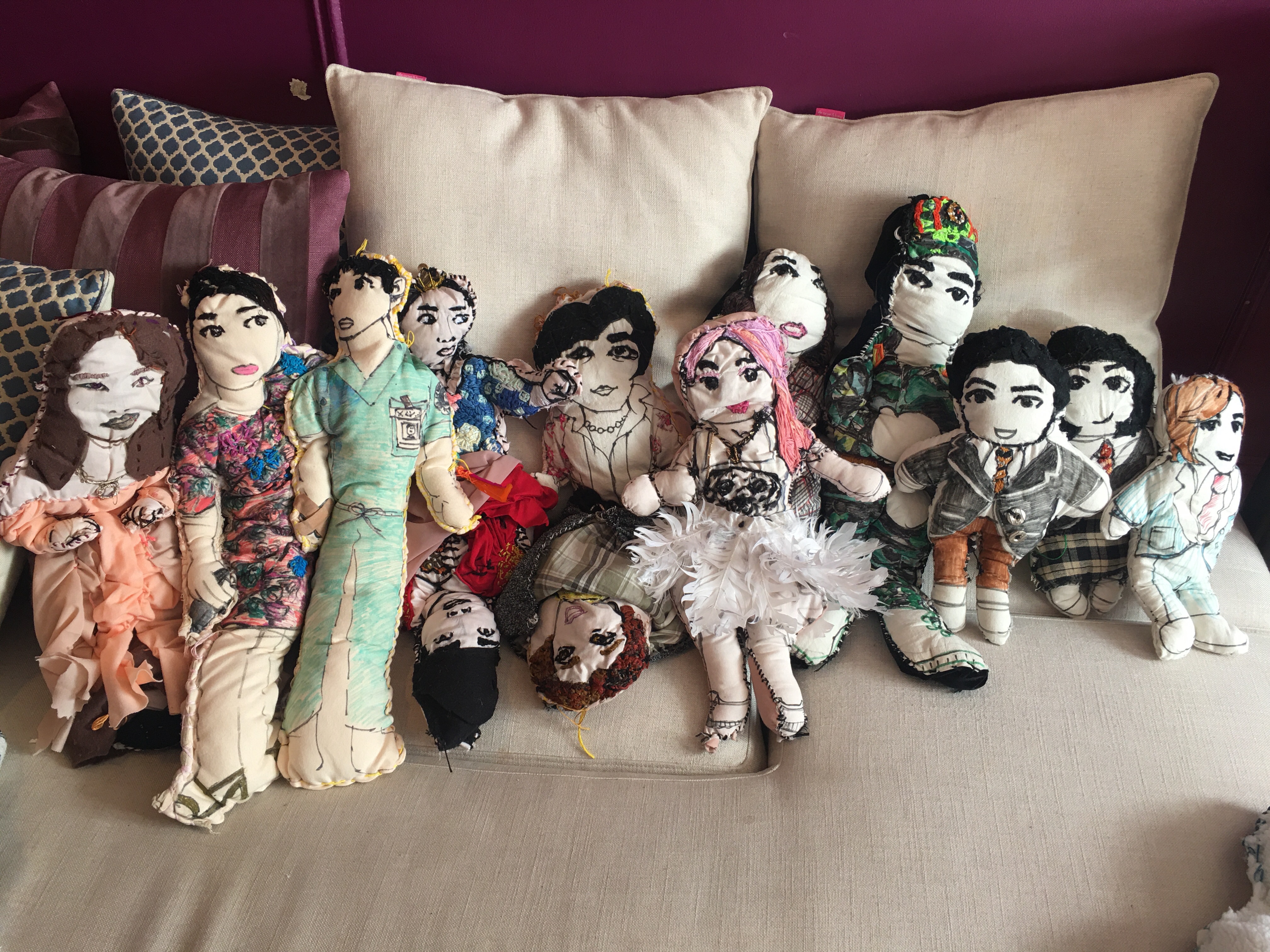
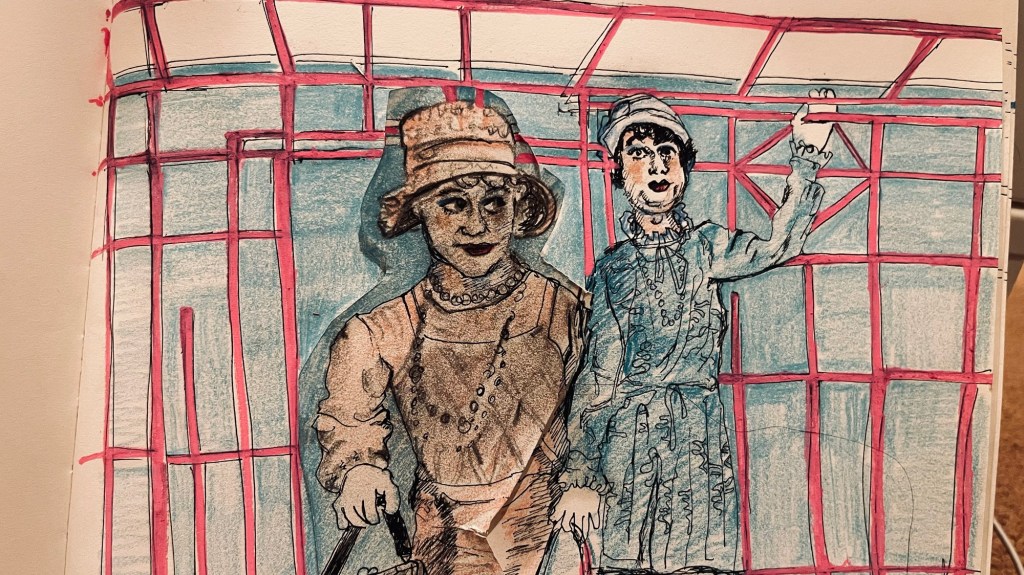
How quickly I compare the U.S. to other countries and rail against our failings when we fall short. (I’m a whiz at self-loathing!) Before writing this post, I had thought that South Koreans with their Confucianism had a leg up on us when it came to the caring for the elderly. I had assumed being a senior in the United States is a more fraught, debased experience than it is in South Korea. This may still be true. However, by one measure– the 2024 World Happiness Report (something I just learned the United Nations compiles each year)– South Korea is seventh from the bottom in terms of the satisfaction of elders and fares considerably worse than the United States. (Score!)
My recent experience touring Cleveland, Ohio’s assisted living residences with my 88-year old mother and even living in one with her for a short trial run before she insisted on returning to her own apartment, suggests that the specter of the euphemistically named “third stage of life” is indeed something to fear. For me, the prospect of aging in America is toe-curling.
Two weeks ago, flying from NYC to Cleveland to help mom, I was the ultimate sour puss; for I’d canceled a long-awaited trip with my husband and two kids to South Korea and Japan to help mom decide if she wanted to move from the apartment she’d lived at for decades largely alone and try an assisted living community. I knew that after staying in a furnished room at one assisted living residence that I’ll call the Manor for a few days with mom to test out the facility, if mom wanted to move, I’d have to pack up her apartment that was drowning in memorabilia and direct the movers to budge unreasonably bulky, once opulent furniture that had been owned by my grandparents while mom micro-managed and no doubt, unleashed a torrent of emotions about leaving her home. (I may have thought, as I have recently been doing lately, I love that woman but couldn’t she have adopted more than one kid on her own? Then I could have the luxury of being the one who lives out of state and merely dabbles in elder care while my sibling dedicates their life to mom 24/7).
It’s no surprise that when my airplane got caught up in considerable turbulence on the trip from NYC to Cleveland, unwieldy air pockets were but one of many reasons I clutched the arm of my seat–quietly hysteric. To me, mom and I are like Jack Lemmon and Tony Curtis in Some Like It Hot–an argumentative, goofy and ineffectual duo. How could mom (with her turtle-paced movements, chronic UTIs/related sporadic memory loss and her lifetime of untreated anxiety) and I (an overwrought bouillon of emotion with ADHD that makes multi-tasking particularly difficult) get the job done?
In the first hour at the Manor with mom, I realized that her greatest hurdle would be ingratiating herself into the morose, strangely cliquey world of the largely Jewish seniors that sat at established tables in the dining room where meals were served. Many of these residents were born and raised in the area and had never left, unlike mom who left as a teenager and spent most of her life in adulthood in New York City. She always had a fun mix of diverse friends: the modern Orthodox Jewish family who used to always invite us over for Passover Seders to sing Dayenu to the melody of popular Disney songs; the brilliant and charismatic Black entrepreneur and his wife who established a long standing Black Rodeo event to Harlem; the Sufi neighbor who taught mom how to make a variety of vegetarian curries; the shy wife of a famous dress designer who trusted mom to keep her confidences since mom was a therapist; the New Age-y Israeli painter and her psychiatrist husband who hosted warm, slightly off-kilter Thanksgiving dinners with turkeys made out of tofu and introduced us to guests like East Village artist” Bee-boo, the skating goddess” who roller-skated through New York–her Raphael-esque locks in her wake.
As I walked into the Manor’s spacious dining room alongside my hunched over mom and her squeaky rollater/walker, I sadly noted that her usually pretty white, soft hair was stringy and pressed flat to her scalp due to infrequent washing in rehab where she had been on her own for weeks. I noted a table of neatly dressed, impressively bejeweled caucasian women who didn’t have walkers in their vicinity and looked years younger than mom. As we passed, they raised their heads like cranes and I assumed by their quickly turned backs and shadowy voices that mom (and maybe I) had not passed muster. Unfortunately, mom like me, has a keen radar for rejection so I know she’d noted their cold reception. The tell tale sign was that she, typically supremely verbose, was unnaturally quiet as we ate our rectangle of meatloaf and made the trek upstairs to her room.
Walking behind mom down the hallways that seemed endless in her labored tread, I felt a surge of protectiveness. Little mama. When I’d arrived fresh off the plane to the Manor, I’d listened to mom’s plea that we head to the lobby’s dining room promptly and ignored her grooming. How could I have not insisted she shower and change into something sharp and even a little status-y like the stellar knock-off Chanel tweed jacket I’d bought her years ago from a Chinese-American socialite I once met in NYC (the closest mom gets to status-y items of late). I felt I’d failed her and lamented that I hadn’t been able to help her find some friendly faces to reassure her and make her feel welcome.
My days with mom at the Manor disabused me of the instinct to tell my kids as I have done, that toxic cliques vanish after high school. Indeed, not all seniors are sweet, all-enveloping, apple pie bakers. They can be brutal. I imagine the cliques in such residences for seniors would be hard to shoulder as there were fewer clique options than in high school. Where was the table of delightful oddballs at the Manor? Where was the boisterous table of drama geeks, or the duo of artsy girls I once knew at school who proudly identified as Wiccan and sewed their own capes? Poof. Gone. Replaced by tables of hard to distinguish caucasian ladies in cardigans and pearls (and a few adjacent glassy-eyed men).
This begs the question: is it possible for the quirky/non-conventional among us to find an appealing, bespoke senior community if independent living isn’t possible? Perhaps projecting to his own very far off old age, my fifteen-year old son asked me if there were queer nursing homes and/or assisted living facilities. When I said I had no idea, his quick online search suggested yes. (Indeed, a few days ago, I took my kids to the Whitney Biennial and though we were largely disappointed with the offerings, one video installation “Ricerche: four” by artist Sharon Hayes intrigued us. Her piece answered our question of whether there were senior communities that were more tailored to one’s interests/identities. The work consisted of several connected tv monitors that were perched on folding chairs as well as a circle of folding chairs for us observers to use. A film played, which featured the artist questioning a group of eclectic, seated elderly residents of a queer assisted living facility about their identities, sex, and experiences aging. The residents beautifully expressed the joy of living with people with important commonalities. (After rolling my eyes at so many lengthy, obtuse museum labels that didn’t much correspond to the art work, I sat down to hungrily watch real humans directly address a question that was on my mind).
Of course, watching this film, I got sidetracked by practical, mundane concerns that I’d been pondering, such as the monthly cost of living at the featured community; was it a Medicaid-accepting facility or expensive for the average American to afford? My search for assisted living residences for mom that would offer her community and a measure of medical support if needed made clear that there are three choices (at least in Cleveland, Ohio): 1) Medicaid only facilities that are often of poor quality, 2) the mid level places that ranged from approximately $1900/month for a one bedroom without meals or almost $3,000/month with meals to 3) the most glossy, exclusive places that went up to approximately $8,000 a month for care, activities and housing. (Of course in cities like New York, these prices are significantly higher).
This all got me wondering if someone who loves art, literary novels and writing like me could find a modestly-priced facility when I get old. How specific are these assisted living facilities for the elderly (e.g, Is there a community for Korean adopted Jews and their spouses) and would living in such a narrow, specific community be desirable or would it feel too cult like?
Unfortunately, the alternatives are paltry for those who can no longer live alone but shun institutional living. Of course, living with family, supposedly the best option for the longevity of seniors at least when families get along, isn’t always possible for those in cities with small spaces.
I’ve read that there’s an increasing trend to try co-habitation, that is shunning formal assisted living residences inorder to live near or in the same space with friends and pooling resources. This particularly appeals to me as an introvert who tires of 24/7 group activity. But this plan assumes that when I’m ready to execute this arrangement, I’ll have good friends who have similar finances, health and geographical preferences to make this happen. In an age when it feels at least for me miraculous when I can can coordinate even a visit to out-of-state friends, I somewhat doubt the ducks will line up for me to achieve this potentially idyllic arrangement.
But psst, friends of mine, please keep my husband and I in mind decades down the line if you want to co-habitate. My husband can regale you with his plum, diverse record collection as played on his comically imposing speakers that are the size of funeral caskets. (Hold onto your hats!)As for me, I’ll be a good Julie the cruise director and come up with plentiful activities that outshine the kind of wimpy offerings I recently saw at the Manor. In perusing the limited roster of “stimulating activities” offered to residents of the Manor, my mother harumph-ed the idea of playing group Bingo. I can’t blame her. Bingo bites. Seeing unfamiliar young children do brief, often unrehearsed performances at the Manor, though well intentioned, similarly sucks. If I were old, this would sink me into a deep depression. I note that there are undoubtedly more elite institutions that offer a better selection of activities but I doubt even the top tier places would offer me rug tufting, creative writing, shoe and handbag design, archery lessons, tarot card reading, history classes, jewelry making, and improv comedy on par with the 92nd Street Y.
I think I have at least two close friends who might agree to co-habitate as seniors and some of my besties are many years younger than me so I am on good course it seems. Though, I note my youngest friend is in her mid- thirties and that’s around where I draw the line. I realize age is but a number and there are some mature people in their twenties but I imagine trying to be good friends with folks in their twenties would be cringey and make me feel like a sad war horse. (Recently taking my eight year old daughter to a Chinatown cafe for art/craft making in a sea of young millennials or when I went to a Mitski concert last summer, I felt the vague itch of feeing out of place. So I need friends at the sweet spot of age.). To this end, in the next decades to come, I will be screening for appropriately younger friends who will visit me when I’m a senior and have the requisite energy, strength, mental facility and of course, interest in sharing time with me (and perhaps whipping up a homemade meal to nourish my weary bod and spare my palsied hands from hard labor).
So practically speaking, it might be time to learn some stereotypical senior games that I’m clueless about like Canasta. The problem is I currently share some of my mom’s derision about most of these games. The only game that truly appeals to me is Mahjong, particularly after watching a pivotal scene in Crazy Rich Asians in which two elegant characters lay down the tiles like a heated, elaborate dance. (P.S. Thank you mom for recently reluctantly giving me grandma’s gorgeous, vintage Mahjong set because if I start learning now, I’ll be a total shark by the time I hit the nursing home/assisted living residence).
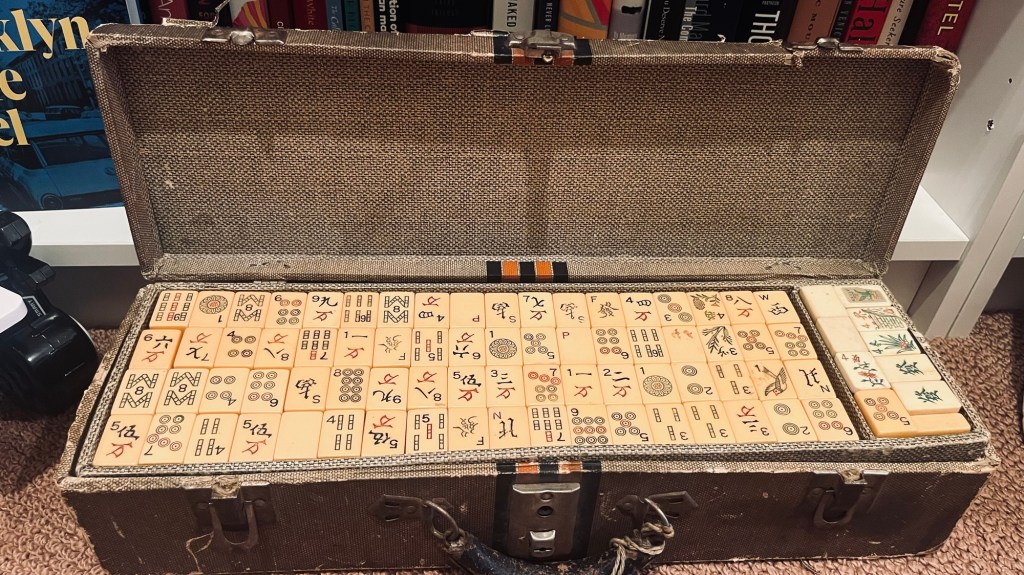
My week with mom has convinced me to diversify my hobbies to allow for contingencies of old age. After fleeing the Manor and settling my mother back at home, I see how much she’d benefit from more hobbies that one can do solo. Right now, mom watches PBS news, laments the existence of Donald Trump and reads occasional books.She could get out of her head more but she’s too physically impaired for yoga. A friend who passed away left her a piano but she has forgotten her childhood piano lessons so it sits unplayed. Unfortunately, gardening, which is widely tauted as a godsend for seniors because of the gentle movement and purpose it requires, is not an option; the only space she could use for plants is her small cement balcony that she never goes on alone. I’ve gone on tangents about how she should write or paint abstracts but as someone who never experimented in her youth with these activities, it’s harder for her to be uninhibited enough to try them now. So learn from this situation readers. Start dabbling with different hobbies now. No eggs in one basket as we enter the sunset years.
We must plan for contingencies now. Recently, the fact that I’m adopted and don’t know my genetic, medical history has made me anxious. After all, my birth family could have been sotted with egregious maladies that could one day befall me. What, for example, will I do if I lose my vision–something entirely conceivable to me as I have shitty, bat-like vision. Of course audio books will save the day if I can’t read one day. But what if my birth mom had searing arthritis that debilitated her hands or maybe even Alien Hand syndrome and I inherit those conditions? Without working hands, poof goes art making as a hobby (unless as my son pointed out I use adaptive technology that allows you to draw with your head movements). Further, without hands, creative writing would be hard for someone like me who can’t speak my ideas as well as write them. I very often stumble over my own spoken words. Perhaps I’m being overly anxious/fatalistic here but I do wonder what hobbies I could do if i lose my sight, taste, hearing and mobility? Quite the challenge. (For my friends whose only hobby is long distance running, by golly, it’s time to diversify!)
Another useful epiphany gained from my week with mom: make friends who are younger than you. If you chance to age well, your similarly aged peers may drop like flies or be so impaired that their companionship is not possible. I came to this dark conclusion after seeing my mom’s excitement to see her similar-aged childhood friend who had been living at the Manor for years prior to mom’s trial run there. When mom approached her in the dining room surrounded by a table of residents, her old friend smiled warmly at her, nodded at me and spoke a few words slowly. I could see the gears slowly grinding as she spoke. We learned she’d had a stroke, which was sad on many levels; selfishly speaking, it sucked for mom because she could no longer count on her to help her transition socially to the Manor.
The importance of a few deep friendships for longevity is backed up by Dan Buettner, a writer and longevity expert I saw on Instagram who has been studying the habits of people who live in the Blue Zones—places like Okinawa, Japan and Sardinia etc where people live into their nineties and beyond. He recommends making sure you have at least two supportive good friends and ideally ones that have good eating and exercise habits as they are contagious.
As I have observed my mom with her recent limited social interaction other than a few hours with a lovely home attendant and near daily calls from the kids and I, loneliness is one of the hardest part of living into your late eighties/nineties. To prep for old age, why not, on occasion, practice the solitary life for at least a whole day and ideally more. Only allow for a few phone calls. Spend limited time outside because leaving the house is inherently social and interactive. Recently, when my husband went to visit my in laws in Georgia with my kids, I found myself alone for four days. To my surprise, I mildly panicked as it’d been a while since I’d been alone for days without friends or family. I texted a few friends desperate for a plan but when the few I reached out to couldn’t oblige such a last minute plea, I resolved to be alone. And I enjoyed it because I knew it was finite. I watched a plethora of films and shows,(Anatomy of a Fall, The Holdovers, The Zone of Interest, Hitler’s Children, Nyad, Tarte and probably more). I drew a little, tore through a good novel (I Have Some Questions to Ask You) and slept in happily. It was glorious, though I realize, not true preparation for the potentially solitary experience of old age. But who knows, maybe learning how to be alone in spurts now will be a salve.
As someone who surely has dismissed someone as a potential friend for a silly, superficial reason (much like a celebrity who said a dating ick was when a guy on a date went “ooh” and flinched when a bee buzzed near him), I see how being so finicky about who you associate with isn’t ideal as we proceed into old age. This could also mean, forgiving people who haven’t been abusive and for whom you still have some affection. I think of my mother and her sister who were estranged for decades yet lived in abutting Cleveland suburbs. They sometimes would bump into each other in supermarkets and not so much as nod hello. Recently my aunt died and oddly my son and I found her funeral on YouTube and watched it. I noted all the relatives who attended–her four children and their children. It was hard not to feel sad for my mother whose friends have mostly passed away already because she would have this large family in her life if not being estranged from her sister for decades. Though I don’t know all the facts regarding the estrangement, it’s hard not to feel maybe these sisters really fucked up when they let each other go. I imagine how potentially rich mom’s senior years could have been if she’d made amends. I picture a spirited revolving door of nieces, nephews and their kids visiting mom in her apartment or taking her on outings when I am in NYC.
Seeing how mom’s life has changed dramatically since her fall many years ago on a rubber mat in the lobby of her apartment building, I implore you to work on your balance. According to a 2022 study by the British Sports Medicine society, the ability to stand for 10 seconds on one leg for those middle age or older predicts survival. But when trying to prove your supreme balance skills, don’t engage in foolery. I recently deigned to spin around on my daughter’s little pirouette board that is meant for an eight year old. Despite my lack of ballet training and natural grace, I stood with one tiptoed foot on this purposely unstable plastic board and then pushed the ground with my other foot and lifted it into the air. How I was stunned when I ended up slammed against the floor is beyond me. Next time, I’m suiting up with a full armor of knee/shoulder/elbow/hand pads (See the offending pirouette board .https://a.co/d/aw6f6HY).
What can we do to sharpen our minds? Perhaps, this is the harder question. My kids and I started a remote poetry reading club with my mom with the purpose of stimulating her mind and providing her with company. This is challenging for all of us as we’re not terribly familiar with poetry and don’t regularly discuss it.Once a week, we have been taking turns reading out loud from Poetry Unbound by Paidraig O Tuama, a collection of modern poems from various poets. Though there are discussion notes to help us and there are some thought-provoking, lovely poems to appreciate and dissect, we struggled to comment on poems like this one:
On receiving Father at JFK after his long flight from Kashimir by Rafiq Kathwari
As I fling my arms wide, he extends his hand.
Recently growing tired of poems, we switched to reading out loud Nicole Chung’s All You Can Ever Know, a memoir that indeed rings very close to home as it’s by a Korean-American adoptee who is eight years younger than me but shares so much common experience. (It’s a sweet experience having my son and eight year old daughter participate in our weekly calls. If you live far from loved elderly relatives, I recommend these weekly gatherings).
How else can we strengthen our memories and our minds? My brilliant, Holocaust-surviving Cousin Abrasha who lived until he was in his early 90’s, used to read the Commentary, a Conservative journal and then read its Letters to the Editors for the opposing often liberal views, which he swore kept his mind sharp. (I note that in today’s particularly polarized political climate, I imagine, this kind of activity might not be popular). My spunky, Nazi-hunting Cousin Basia who lived until her nineties, had me come over every Sunday when I was in high school to read her the New York Times out loud. She’d correct me if I mispronounced any names of countries etc (but yet my abilities to pronounce countries correctly is abysmal). So take note and keep your subscriptions rolling. (Or do what I’ll probably do—continue my daily Spelling Bee and pray it staves off early dementia).
When considering what life habits I ought to consider, I often lazily rely on anecdotal evidence. Since my grandpa Benny who lived until his early nineties swore that eating a half grapefruit a day for breakfast was the reason he was so healthy, I never turn down a grapefruit. He also died with the thickest white mane of hair I’ve ever seen on an elderly person so maybe grapefruits are good for follicle growth. Drinking lots of water, a classic prescription for good health, has always been hard for me. Recently I cashed in a gift certificate to the Mandarin Oriental spa from my 50th birthday and in a haze of robed glory, drank six glasses of the free pineapple and lemon infused water they offer guests. I went home and made a large jug of pineapple and lemon ice water and happily watched my kids down glass after glass of this simple but strangely delicious concoction. (I’d never thought to add pineapple to my water). Here’s to hydration! I resolve to eat less take-out food though this is hard for me with the increased ability to order from restaurants outside the meh-cuisined UWS and to stock up on things that are probiotic like kimchi. The longevity expert on Instagram I mentioned earlier also waxes on about the benefits of eating beans and fiber. (Beans, glorious beans?) I am skeptical because I’m no great fan of beans and think increased bean intake bodes poorly for wanting to increase socialization/maintain friendships, which is also apparently good for one’s health. My conundrum: beans or friends.
I’m no health nut or nutritionist so my family waved me away when I recently declared we’re eating healthier. They rightly chided me for the fact that this random Instagram guy mentioned above has me decrying my high sugar and meat diet. As they know, I have good intentions but get easily side railed, e.g., see these winsome Korean snacks. They may be processed but they’re made of sweet potatoes and thus have fiber. Check out these beauties! (Please don’t kick me out of our 2050 senior friend village just because I do enjoy some junky snacks and my habits are contagious!)
L’Chaim!

 Crazy middle class asian