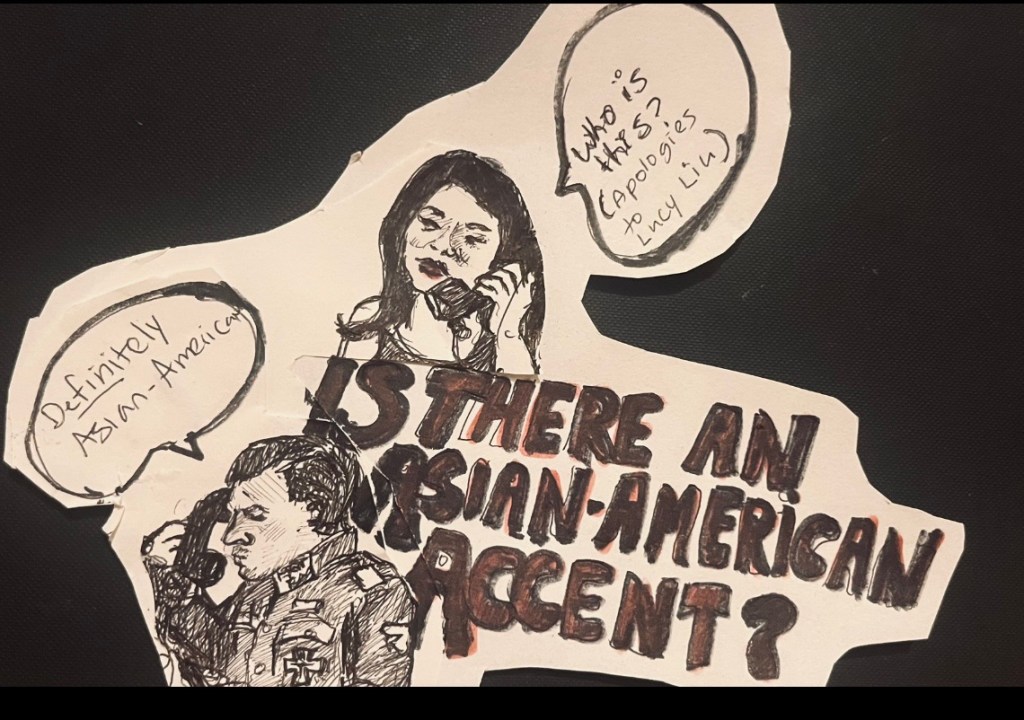
I can’t be the only Asian-American having a knee-jerk, surly reaction to online discussions about the existence of an Asian-American accent. Notably, this isn’t about the accent of first generation Asian-Americans but of Asian-Americans who have spent most of their lives in the United States and speak fluent English. Some Asian-Americans who have been singled out online as having this accent are: Ali Wong, Randall Park and Lucy Liu. To my great relief, it’s not white folks driving this discussion this time but Asian-Americans who are saying they can recognize if someone is Asian-American on the phone. (Though of course, Asian-Americans can be legit racist/self-hating; I’m fairly sure that it’s we Asians who came up with the expression FOB (Fresh off the Boat), derogatory slang for recently arrived Asian-American immigrants who are unable to blend in due to dress, speech, poor driving skills etc).
As 24-year-old linguist Adam Aleksic says (via his fun Instagram account that my teenage son shared with me recently), some linguists think it’s possible there is an identifiable accent but have not been able to conclusively define any common features (e.g., tendency to speak in a higher pitch). As Adam wisely notes, perhaps Asian-Americans are such a diverse group that linguists won’t be able to find commonalities in their speech.
Maybe I’m deluded, but I am pretty sure no one has ever guessed I am Asian-American based on my speech alone. (For those who know me, I won’t cancel you if you tell me otherwise. Pinky promise. But please do not say my hesitating, wavering manner of speaking is a give-away. That’s just me, not all Asian-Americans, you dweeb!). I realize, I’m a bit of an outlier who is probably outside any focus group since I was raised by a Caucasian Jewish mother and had scant interaction with Koreans/Korean language until later adulthood. If I have any kind of Asian-American accent, I’d be low-key flabbergasted.
Admittedly though, part of me wants to call every Asian-American friend/acquaintance I have and listen for any speech patterns/inflections they have in common. If I call you up, please don’t be offended; I’m but an amateur linguist conducting a study! (This tangentially reminds me of a guy from law school who once called a group of female students including myself–insisting he was participating in a NYU study with the Psychology program and conducting a survey. His lone question: How attractive do you find me on a scale of 1 to 10? He asked me this–his voice deadpan– and was undeterred by both the quiver of amusement in my voice and my interjections of “Are you serious?” As he was a fragile, sweet guy, I let him continue his venerable study and tossed him a generous rating. But scientific research, my foot!)
All this content about the Asian-American accent is, dare I say triggering because it harkens back to enduring meals while white people, within ear shot, mocked the way Asian-Americans speak English. Take an evening in my twenties at Katz’s deli with a group of frat-ish law school graduates–basically a bunch of white, baseball capped men and a small scattering of us women. The handsomest guy in the group–not surprisingly the most arrogant of them all– made fun of a nearby Chinese bus boy’s English. You know the hilarious kind of impersonation white people have historically been so good at: “Would you like some flied lice, please?” Then this cruel hottie turned to me–his head cocked as he studied me and shot me a confusing look–both lasvicious and scouring at the same time. I’d not felt comfortable back then to rage but simply looked down at my lap and stewed. In my defense, it’s always been okay to mock Asian-Americans overtly until recently. Righteous indignation just wasn’t in my wheelhouse!
At least, I thought this kind of behavior was relegated to the past; my son recently described how a new substitute English teacher, a middle-aged white man, without pausing to reflect, started reading outloud their assigned book by Asian-American author Alexander Chee in a ridiculously stereotyped Asian accent as students took videos in disbelief. (Unlike the past though, there were consequences; the sub teacher was asked not to return).
I hesitate to see the merits of finding there is an Asian-American accent. Why try to clump all of us Asian-Americans together? (That’s never worked out well for us). I am a little taken aback by the statement of Jerry Won Lee, the director of the International Center for Writing and Translation and director of the Program in Global Languages and Cultures at the University of California, Irvine : “On a positive note, if there is such a thing as an Asian American accent, I don’t think it’s going [to be] as pathologized as it would have been when I was coming up, because of things like K-pop. If there is an Asian American accent, it’s not a bad thing. It’s just a thing.” Call me a sour alarmist, but I am skeptical that K-pop has saved Asian-Americans from a long history of ridicule and racism. (Oh and violence against Asian-Americans is still occurring, sir).
My husband, kids and I could be content linguists. To begin with, we are pale bibliophiles who can’t recognize names of famous athletes and scratch our heads when friends wax on about their winter breaks on the ski slopes. My kids remind me (in this context at least) of Snow White’s Grumpy Dwarf who trails behind his jolly cohorts–his arms crossed to his chest–as they march towards the mines and a day of grueling physical enterprise. The only time we hold anything approximating a tennis racket is when we swat mosquitos with those bug zappers that make summer evenings bearable. So we’re certainly nerdy enough to be linguists. (Apparently, according to Reddit chatter, computer scientists and linguists are head to head in this competition).
Take my nine-year-old daughter who has recently embarked on the task of learning Toki Pona, which is a mind-bogglingly tiny world language that was created by linguist Sonja Lang in 2001. There are supposedly thousands of speakers and they have their own Discord and Facebook page. (Toki Pona has approximately 137 words as opposed to English’s 171,476 and Spanish’s 100,000).
Supposedly, Ms. Lang loftily created Toki Pona (“The Language of the Good”) with the goal of distilling words down to the basics in order to find the meaning of life. (As a devout maximalist, I can, in theory, appreciate this asceticism). As my daughter explained to me, the language has no past and future tenses, no pronouns and most words have very broad meaning, e.g., there is one word to mean animals who are mammals but not a word for every specific mammal.
My sweet slip of a child who still creates elaborate scenarios for her stuffed animals, recently suggested that instead of me yelling out the f-word or its variations when I think no one is listening and I’m overloaded with irksome household chores like dish washing or experiencing something even more harrowing, I could yell out “pa-ka-la!”, which according to the Toki Pona online dictionary means to botch, to damage and is the closest equivalent of the f-word. (Bonus for my readers: if you want to yell “f-you” you’d say “pa-ka-la sina.” See, I do provide you useful information!). My youngest is such a devotee of the language, the past few days she refuses to get out of bed in the morning without a struggle unless I say,” len,” which means “clothing” in Toki Pona and is the very simple way Toki Ponians direct another to get dressed. With this magic word, my daughter pops out of bed and gets dressed!
Regardless, I’m hesitant to take up this niche language despite the appeal of potentially mastering a language in lightening speed and despite my daughter’s welcome(though surely short-lived) acquiescence described above, because Toki Pona sounds much like the jibberish/jabberwocky spoken by the Minions. Both sound like a funny amalgamation of different Asian languages and Spanish. Though I am mildly intrigued by Toki Pona’s minimalism and economy of words, I’ll let my kid be the resident Toki Pona expert. (After all, I don’t need to feel more like a cartoon character than I already do!)
Plus, I am displeased that Toki Pona has such limits, e.g., replacing the satisfyingly expressive, cathartic English word (fuck) with a dopey, sing-song-y one (pa-ka-la). What rot! When I am mad, I need a word that conveys that, not something that sounds like Kumbaya! (This reminds me of the tiresome fifth grade “friend” I had at Riverdale Country Day who demurely replaced the world shit with “sugar”–to my silent derision.)
Further demonstrating the limits of this primordial language are the kinds of books written in Toki Pona, e.g., a, skeletal, dry version of Frank Baum’s The Wonderful Wizard of Oz that is devoid of the original’s adjectives and imaginative details. I took a quick peek inside this book and the word “scarecrow” was translated as “person of bird removal,” which makes me think of the animated children’s movie, Home, and the alien Boovs’ funny version of English. Afterward: The other night, my daughter and I realized that Toki Pona doesn’t use English letters but has its own complex symbols. Given this, I question the energy she will spend learning this odd little language when she could learn a practical one like Korean or Chinese).
Other delightful fare: Adam translating Romeo and Juliet into his own created bird language of intricate chirps and in another reel, discussing diffusion of information theory, which explains how slang is created and disseminated. According to the theory, slang usually originates from the Innovators who make up 2.5 % of all people. Innovators, he says, are those wiling to take social risks. (For modern slang, innovators are often from particular communities -queer and/or Black–and use language to build community). For a word to move to the Early Adopters (people in society with a platform/ elevated status such as celebrities/influencers), the word must be unobtrusive (can’t be forced) and be easy to recombine into many phases, e.g sigma, what the sigma, on sigma. If the Early Adopters use the word, the mainstream follows in order to signal membership in the cool group. When the word is ubiquitous, it loses its edge and the Innovators must start again. (Adam’s recent illustrative pop cultural reference: how the character Gretchen in Mean Girls tries to make the word fetch a thing but fails to spread it to the Early Adopters (Regina George and the other girls).
But let her be! For who am I kidding, I’m probably the second in our family most likely to wile away my hours learning an obscure language (say Egyptian hieroglyphs) when I ought to be learning a robust, practical language like Spanish so I can communicate with actual people in my life. Though I avoided taking a Linguistics class at college because I’d known some brilliant people who eek-ed out a C in the famously challenging class, I delight in annoying my children by asking “where did that come from” about each new morsel of Gen Z and Alpha slang that I overhear. I note that I’m in no way unique. Countless celebrities, e.g., Padma Lakshmi and Betheny Frankel, have fluffy online content that features them probing their skittish yet amused teenage daughters about their use of slang. Even world leaders sometimes get fired up about slang, e.g. North Korea’s Kim Jung-Un’s laws in 2021 that banned the use of South Korean slang by his people.
In my home, we do find ourselves discussing language often. Recently seated at our dining room table planning our upcoming trip to England for a family friend’s wedding, we amused ourselves by learning some Cockney slang and imitating the accent. My nine-year-old daughter, having recently devoured the film Les Miserables (the Ann Hathaway version) that’s rife with Cockney, spent our meal asking us to pass her “a bottul of wahh-tah.” She also taught us some Cockney rhyming slang, e.g. “What’s the lemon?” means” What’s the time?” In what seems like drunken logic, lemon became the slang for time because time rhymes with lime and one associates lemons and limes; hence, the use of the word lemon. We do use this expression ( just in each others’ company) now.
Unlike some mothers who are wasting energy trying to be the “cool mom” by adopting their kids’ slang, I only like to learn it so I can drive my kids mad. Fortunately, since my kids generally brush me away when I try to deeply probe their secret code, there’s abundant linguistic content online that is sufficiently watered down for me to absorb late at night when I’ve got time to myself. (See 24-year-old linguist Adam Aleksic discussed earlier). From him, I learned that a paragoge is an additional sound that is added to the end of a word, e.g., adding an ee sound to a word to make it diminutive like adding -ee– to the end of John to say “John-ee.”) He claims that white girls have unintentionally created a new grammatical feature in what he calls “white girl paragoge,” which is when mostly young white women unintentionally add the “ah” sound to a word to serve as an exclamation point, e.g., “ew-ah”, “no-ah!” or “stop” (st-ah-p). As he notes, in the past, exclamation in English could only be shown by intonation of your voice. Ahh the societal contributions of white girls at the mall!
My daughter recently told me her third grade classmates were openly aghast when their teacher who is apparently not young/worthy enough in their eyes, tried to use the world slay casually. (Good Lord woman, learn your station!) But for those of you trying to stay abreast of Gen Z/Alpha slang for any reason, misguided or not, the NerdyEtymologist predicts that slay will soon be replaced by “I’m gagged” as a word of queer excitement since that phrase has supposedly been trending in the queer community the way slay was before and may soon be adopted by straight white girls on social media. One of many reasons I will not be partaking in this expression (other than assuming it should be reserved for the littles), is that it sounds too much like “gag me with a spoon,” from the 1980’s Valley Girl repertoire, (though I realize these two expressions have different meanings).
With due respect to the diffusion of information theory, I leave you with my selection of fun old/current slang from other countries that you may hear me trying out. I know that I lack an iota of influence or cache and that I’m no Innovator or Early Adopter; I’m just sharing this with you to give you a chuckle. Enjoy!
Slang that would be fun to use (at least in writing):
- nojaem, which is Korean slang for “no fun.” I think I’ll Anglicize this word and say “he’s no jam” to mean “he’s no fun.”
- dag, which is Australian slang for “a rotten person.” In New Zealand, dag means a fun person. I think it works better as a negative word. “That actor is such a dag!”
- “Use your loaf,” a Cockney expression meaning”Use your head.” I plan to say this to my children etc. I like the humor of equating our hard heads with a squishy loaf.
- hoosh, slang meaning to raise, lift up. I like the sound of this. “Just hoosh her up to see the floats.”
- skive off/skiver, British slang. Skive off means to get out of work or school by pretending to be sick. Or used as a noun; he’s such a skiver! This seems like a useful word without an English equivalent.
- gutted, British slang for being devastated. I didn’t think this was really slang and feel like people say this in the U.S. but I like it plenty.
- “It’s cactus,” Australian slang that means “it’s broken, irreparable.”
- zib, a Victorian slang word for a nincompoop. I like this as there are fewer and fewer words for someone who act dumbly that are acceptable these days.
- sauce box, is more Victorian slang and means mouth. I like this better than another expression I’ve heard– “pie hole.” It may be less funny but I like that it’s less aggressive than saying “shut your pie hole.”
- bully, old-timey American slang to modify an adjective, e.g., “she looks bully fine.” I like it. Not sure if I’d use it in real life but maybe in my writing.
- an egg, 1920’s American slang for a rich person. I will use this. “He’s an egg, but you wouldn’t know it from the way he dresses.” Kind of adorable word for a rich person. The rich often need way to soften/make them more lovable!
- oofy, late 19th century American slang meaning wealthy. A fun to say adjective.
- gasser, American slang for a bragger.
- juke, slang from Gullah, an English-based creole language spoken primarily by Black Americans living along the coasts of South Carolina and Georgia, which means “disorderly, wicked.” I like the sound of this word.
- tgeom-eunmeoli-oegug-in, Korean slang meaning a black haired alien or Korean in name only. I won’t use this because it’s mean to my fellow aliens and because I’d need to shorten it and I’m not sure how. I didn’t know there were negative feelings about us Korean-American adoptees amongst Koreans. Boo. I think I’m going to go all in and lean into my alien status when I visit. (You know, flash my show stopping metal adult braces (no Invisaline for me) and go barefaced with not even a drop of moisturizer when I visit my Homeland next time).
- to get beaned by something, 1910 American slang that meant to get walloped in the head by something. I like expressions that make something harsh/violent sound cute.
- beezer, 1910 American slang for an intelligent person. It’s nice to have some variety for this word. I can only think of these: brain, smartie, nerd, genius.
- bosh means “empty or worthless” in Turkish. This was used in 1910’s America supposedly. I can very well imagine myself yelling “bosh!” in annoyance at something/someone.
- lunker, American slang from 1910, which means a person or human that is large in size.
- sorner, American slang from the 16th century for a person who mooches off someone else.
- a rake fire, American slang for a person who stays so late they outwear their welcome. I love a hard-to-decipher insult. You could say to your spouse at the dining room table about your unwelcome guest who joins you, “the fire might need raking.” (Of course, this would require the existence of a fire place in your home).
- sand, cowboy slang for strength. “You’ve got sand, that’s for sure.”
- “Go pop your corn,” cowboy slang for “say what you have to say.” It sounds vaguely naughty but I think it’s a fun expression.
- mush head, cowboy slang for someone who lacks intelligence.
- an apple, 1930’s American slang for a head, e.g,”watch your apple when you stand up!” I love this.
I’d love to hear from you what slang words you use and if any of them come from the past/other cultures.

 Crazy middle class asian