The Korean bungeoppang reminds me, of course, of the German word doppelganger. A doppelgänger is a biologically unrelated look-alike or double, of a living person. In fiction and mythology, a doppelgänger is often portrayed as a ghostly or paranormal phenomenon and usually seen as a harbinger of bad luck.
If you are drawn to the Twin Stranger app–charmed by the idea of finding your real life doppelganger, you are apparently not alone; though you may be deflated to learn that with 7.4 billion people on the planet, that’s only a one in 135 chance that you’d find your exact genetic match, which means the odds of finding your exact doppelganger on these apps that are unlikely to contain a significant fraction of possible human faces, are miniscule. If you are not a stickler for exact facial measurements and are simply looking for a close enough match to confuse friends and family (at least upon first glance), you could surely find someone approximating your doppelganger.
The question must be asked: why would anyone want a doppelganger? Sure it could be a riot to have an identical twin for clothes sharing, friendship and the occasional elfish hijinx like trading romantic partners and seeing if they would notice or having your twin sit for your high school Physics exam in your stead. Plus, it’s true that recent rumors that Putin had a doppelganger take his place at a meeting with North Korea’s Kim Jong Un, highlights the advantage of having your doppelganger attend all your dreary, obligatory meetings. (I enjoyed learning about online detectives’ dubious proof that Putin used a doppelganger, e.g, the fact that the Russian dictator, not a known hugger, had given Kim Jong Un a Charmin- roll-style squeeze, and been uncharacteristically smiley during a meeting.) Just imagine being so rigid, scary and powerful that if you once subtly changed your mannerisms/demeanor to reveal actual human emotion, observers would allege your use of a doppelganger rather than assume a more pedestrian explanation, e,g, a good fart release or an impromptu morning fuck.
But at some point, as I have seen with real life identical twins I’ve known, I’d probably grow weary/hostile of the uniformity and the burden of having men see the two of us together and flank our sides (with their pervy, twin fetish); I’d want to assert my uniqueness.
From what I’ve absorbed about doppelgangers, it’s not all fun and games when you are confronted with your non-genetic twin. After all, they show us our potential/who we could be if we’d made different choices in our life or had different advantages. They often elicit feelings of jealousy and inadequacy. I recently read that Taylor Swift has a doppelganger and as a reluctant, only sporadic fan, I envisioned her mopey and fully immersed in a gilded, Liberace-grade, champagne bubble bath–those razor blue eyes peering out of the mist at a looming TV screen with an image of her look-alike. I’d fret if I was her too! For might her doppelganger be the radical who donates one night of a stadium concert to low-income people who can’t afford her concerts and gives her money to American cities regardless of whether they are hosting her tour in the near future. Maybe her clone would have raged an early campaign against Trump and thus changed the course of our looming Presidential election. Or perhaps this doppelganger would so destabilize Ms. Swift/make her question her identity as doppelgangers are apt to do, that she’d whip up a new album full of authentic, fresh angst that I would gleefully purchase for myself( not just my nine-year old daughter).
As a Korean-American adoptee, I’ve predictably nursed fantasies of finding my long lost twin like the identical ones in the documentary Twinsters who were separated at birth and adopted by different families in different countries only to, as teenagers, find one other through social media. The closest thing to meeting my doppelganger was dating a Taiwanese-American guy in college who was basically my male equivalent in looks and personality. He was around 5 “10” to my 5 “6”, and had tan skin, coarse, slightly wavy hair and a bright smile. Other than our appearance, we had many commonalities: we were soft-spoken, laughed easily, and liked to dance at parties; we didn’t have to shave our legs because our legs were hairless; he was a good illustrator who drew me personal, slightly corny cartoons at regular intervals that delighted me and had a kid-like appreciation for small, ordinary moments. (That said, he was better at math, was less shy about public nudity as his track team and he were known for campus streaking and as I recall, was a neater, more corporate version of me. I say this because I once caught him ironing his chinos in my dorm room, and I have surmised that as an adult he works for a big company). The extent of our similarities made me grateful he was squarely not adopted and not Korean or else I’d have worried about a potential genetic link. The two of us were sometimes told we looked like siblings (to our dismay) and this fact, may have even contributed to our break up. (There is a certain ease to being with someone so similar but ultimately, I think it’s not life-affirming/sexy when you don’t feel sufficiently unique in a couple).
As I’ve droned on about time and time again, like most Asian-Americans, I am regularly mistaken for other Asians; is it clumsy to write that, accordingly, I’ve felt like I’ve lived my whole life amongst many doppelgangers?
Most recently, I trekked to the suburbs of Maryland to celebrate a friend’s daughter’s bat mitzvah. I was uncharacteristically early so I stood outside the locked synagogue doors with a sixty-something -year- old woman (who turned out to be my friend’s out of town relative) and politely smiled hello. She peered closely at my face and bust out with”Ah you must be (my friend’s name here) boss!” Confused, I cocked my head to one side–trying to recall the identity of my friend’s boss. Then it hit me: my friend’s boss was a big shot in the federal government who was easily Google-able. As subtly as I could, I lowered my eyes to tap at my phone for confirmation: my doppelganger was a middle aged Asian-American woman, whom to my trained eyes, was definitely not my physical twin. (Though maybe I should be happy this lady saw my sweaty presence in my long dress that was admittedly too heavy for summer and mildly crushed-in-the-toe black party shoes and thought “powerful Asian lady.”). My tip for white people who are the main offenders re: this misidentifying business: if you aren’t a hundred percent sure of our identity, stop acting like a drunk guest at an auction, e.g. tearing through your limited mental catalog of Asian faces, shouting out something (cross-eyed) and hoping we say “Sold!”
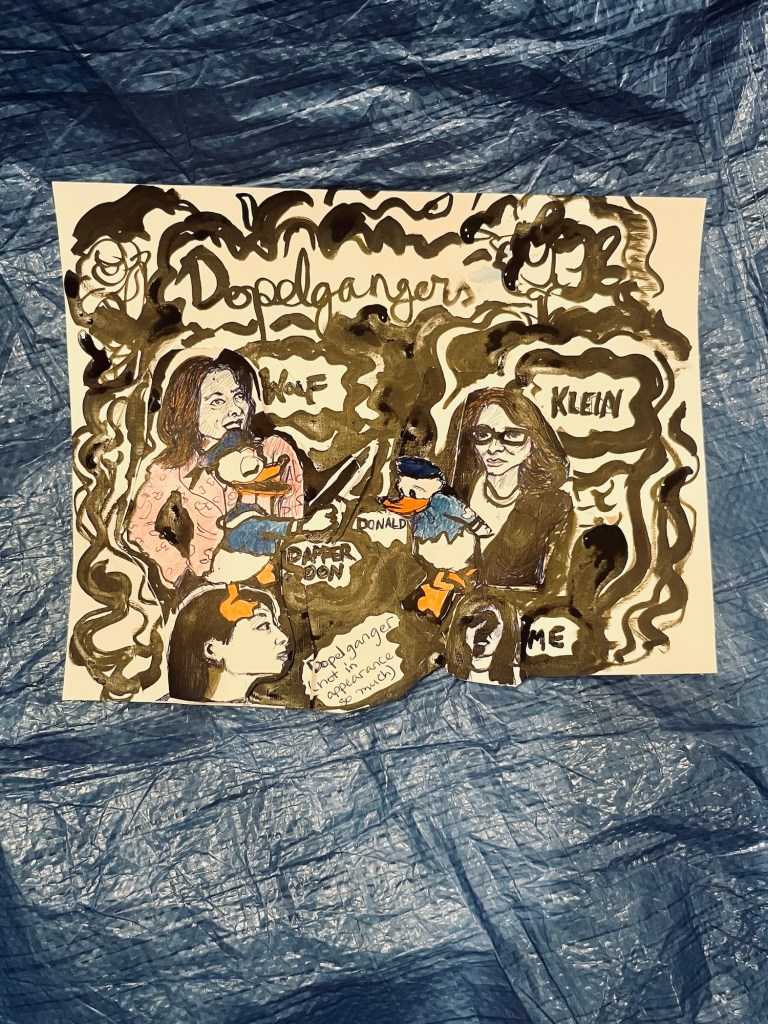
Though I typically wave away other Asian-Americans as being sufficiently different from me, and grow insulted when I am misidentified, I recently discovered that I may have a bungeoppang. Though unlike well-established Lefty political writer Naomi Klein (who most recently wrote the enjoyable, easy-to-plow-through book Doppelganger that is, on its surface about being perpetually mistaken for equally famous feminist author turned COVID anti-vaxer Naomi Wolf), I’ve got no writing gravitas. My doppelganger/bungeoppang, writer, E. Tammy Kim (“ETK”), is perhaps not yet a universal household name like Naomi Wolf (who is maybe best known for writing the Beauty Myth), but she’s a journalistic force, well on her way. (Frivolous side note: ETK, at least in the few photos available online has some of the hallmarks I have of being Korean-American, e.g., dark hair and eyes, but we aren’t physically identical (except, of course, to the average white person.)
I learned about my doppelganger‘s existence when my new boss whom I appreciate- a bearded hiking aficionado and skilled advocate with a soothing voice and pale, faraway eyes that make him appear un-phased by anything–asked us (his supervisees) to read an article about community lawyering. While reading the piece, I noticed two things: it was spectacularly engaging/well-written for an instructional article and it was penned a few years past by a writer with a distinctly Korean-American name. I took note of these facts (and, indeed, processed that we were not only both Korean-American legal services attorneys in NYC, we were legal services attorneys in the very niched area of labor and employment law). I then promptly buried this morsel in the recesses of my mind until a week later when I found myself in the office with our summer law student intern.
In the confines of a bland but sunny conference room, I made small talk with my summer intern Sam–a bright, positive guy with a media/journalism background and a young person’s quick mind and ability to categorize people in helpful ways. I found myself confessing I’m trying to one day transition into journalism or novel writing, which broke up the long bouts of silence, document review and the dull, studious tapping on keyboards that are the hallmarks of the attorney life. Nonplussed by my slightly off-kilter confession, my intern suggested I contact ETK, the Korean-American journalist who wrote the article we’d all just read the week prior about community lawyering. After all, she, he noted, is a brilliant writer who used to be a legal services attorney and now routinely writes about labor issues, Korean-American identity and much more as an editorial staff writer for The New Yorker.
News of such a person’s existence, made me feel immediately gut-punched, sallow and raspy-voiced. (Think of Joe Biden at last night’s debate with Trump. Now that’s someone in need of a fit doppelganger!) For I’d been supplanted! I scrolled through article after article by ETK in The New Yorker and near-gasped at the sight of articles on topics that made my mouth salivate, e.g., profiles of artists I admire; see Käthe Kollwitz’s Raw Scrapes and profiles about Asian-American politicians, buzzy, interesting TV shows I’ve appreciated, union stories, Korean adoptees and even a piece about Ohio (specifically, a town called East Palestine, Ohio)!
I also felt a certain embarrassment that I, a spotty but appreciative reader of The New Yorker, had zero recognition of my doppelganger’s name. (As someone with ADHD who has been a prodigious scroller and skimmer of books and articles, I perhaps should not be so hard on myself. Quite illustrative, years ago, I read the novel the Perks of Being a Wallflower so fleetingly that I was outright surprised when years later, I chanced to see the film on TV and discovered the central dark plot line involving a treacherous, pedophile aunt, which I had somehow missed in the novel. It had, indeed, struck me as a fun, breezy novel).
As one online author noted on the topic of doppelgangers, “[s]eeing someone just like you can make you feel totally displaced. While part of you might want to take on the world together, another part of you might think, ‘What’s the point in me any more?’”
Indeed, what is the point of me anymore, I whined to my old friend Michelle when I called her the following evening to whine about my doppelganger‘s existence. Sounding a little like Hamilton‘s Aaron Burr, my friend assured me the world was indeed big enough for the two of us. (Sorry for the tired reference and the other ones to come that are littered throughout this post, but a week ago, I saw Hamilton in London and the lyrics are re-booted in my mind). After all, my friend asked, does my doppelganger make performance art parties in Central Park, draw and make art and does she have my exact upbringing and perspective as a Jewish Korean-American adoptee scholarship kid? (Well, I doubt she ever ever used a massage table for a bed as a tween but ETK has co-edited “Punk Ethnography,” a book about contemporary world music so her wingspan of topics and skills alarms me. She’s no slouch).
At night, after work, I fell down the harried vortex of researching doppelgangers in art, literature and pop culture for hours and this continued for days. As I did my research, I noted that doppelgangers are often portrayed as arch rivals who are better, or more actualized versions of the originals.See Netflix’s lightly entertaining Living with Yourself that I recently watched in large part due to the universal appeal of Paul Rudd who plays Miles–a depressed middle aged suburban husband who goes to a foreboding, sterile spa run by two Korean men who clone him for $50,000. Soon after the cloning procedure, we see the original Miles–disheveled and confused– as he stumbles down a dark road in nothing but an adult diaper while his neatly clothed counterpart with his sunny, confident sheen appears on screen. The unleashed clone tells stories that charm Miles’ wife and party guests, gets hit on by alluring coworkers and shows off his impressive (or, at least, more niched) vocabulary, which helps him when he slips seamlessly into Miles’ advertising job. (See the scene in which the doppelganger explains to Miles that his newly created advertising campaign involves two farmers shaking hands across a stile and then has to explain to Miles what a stile means).
I especially enjoyed the scenes in which Miles attempts to finish up a play he’s been eeking out on his computer but is ultimately distracted by animal YouTube videos (and porn ). When another day, he returns to his laptop to write, he discovers his doppelganger has been, without his consent, fruitfully writing new pages of his play since he’s not similarly riddled with Miles’ Writer’s Block. Huffing with rage, Miles deletes all the new work. Such a telling depiction of the internal struggles of a writer! (This is so reminiscent of me–one day seated at my laptop smacking my lips in anticipation of a productive writing sprint only to produce two paragraphs and return the next day to delete both paragraphs in disgust). Though Miles decides to keep his doppelganger in his pocket to better his life (e.g., charm his boss and his wife), he resents him as seen in a later, comic dog-eat-dog wrestling match. Without providing too much of a spoiler, in the end, the doppelganger who initially charmed Miles’ wife and got him a promotion at work, in some ways falls short of the original. As one online reviewer said,”the show reveals Director Timothy Greenberg’s ambivalence about the whole self-improvement thing; shed the old self and what, exactly are you left with? “
To my amusement, the plot of this palatable, one season TV show, largely echoes a short vintage Disney film Donald’s Double Trouble, that features the famous cartoon duck bumping into his doppelganger British Dapper Duck who is a more refined version of himself with perfect diction and manners. Donald pays his suave twin to win back Daisy Duck who had recently broken up with Donald for his slovenly ways but in the process gets enraged and jealous of his doppelganger’s romance with Daisy and in the end, is reunited with Daisy, despite his flaws.
Watching these two shows/films (Double Trouble and Living with Yourself), I can’t help but wonder: Is the gifted Korean-American writer E. Tammy Kim (“ETK”) the polished Dapper Don to my squawky, unrefined Donald Duck?
Last week, after dinner, I sat with my laptop and my teenage son at our dining room table, mildly crestfallen and enraged as I read article after article by my talented and prolific twin. Unlike this blogger who eeks out words like a stuttering infant with a lifetime ahead, my twin clearly writes like she is “running out of time.” My son (my biggest writing booster) took a few minutes to read one of ETK’s New Yorker articles and once done, patted me on the shoulder–no doubt to console me; my doppelganger, he admitted, has a playful writing voice that sounds a little like mine; though my dear boy was too magnanimous to say what I was thinking: ETK’s a more polished writer with a larger wingspan of knowledge. The cherry on top: we learned she was a co-host on the podcast Time to Say Goodbye that explored Asian-American identity for years before it ended; so unlike me, she’s comfortable with her spoken voice too. See, she’s me–only improved! Aw, Quack!
Affer I decided to write about doppelgangers, I uncovered a swarm of new facts that laid bare our respective Dapper Don and Donald Duck identities: according to her Instafeed, ETK draws and makes art as hobby; she wrote poetry that was published and, gasp, may have even won a poetry prize (so she isn’t a one-trick writer); in my life, I too have written some poetry (albeit, the mediocre, unpublished kind). She even has a Substack newsletter called TKTKETK so she’s basically an updated, relevant blogger in her spare time (who of course is able to discuss her New Yorker pieces etc).
So you see how ETK and I are (practically) like two side-by-side casino slot machines? Each new pull of our respective levers reveals a similar fact; her lemon is my lemon! Though her Yale education to my Carleton College suggests she’s possibly smarter or at least more focused than I; for her voluminous, high calibre pieces in prestige publications suggest she is someone whom my therapist might observe “takes herself seriously.” Dare I extrapolate that in high school, she didn’t belittle her own talents and refuse to submit her poetry to the school literary journal, which forced her teachers to do it covertly. Dare I assume she probably didn’t reel after each rejection/each publication that ignores her submissions and/or refuse to apply anything new after each discrete rejection? If she’s like me and her parents didn’t support her creative pursuits, no doubt (unlike me) she’s processed that wound and has moved on by now.
Or maybe I’m putting her on a pedestal and am unnecessarily debasing my self, which I’m a maestro at. But, you my readers, may be glad to know, I’ve advanced the plot (something I struggle with in my novel writing) and am not just whining; ten days ago, I emailed ETK about our commonalities and asked for career-change advice. (Thankfully, it was pleasingly easy to find her New Yorker email address).
This is what I wrote her (feel free to judge me and edit it in your mind after the fact):
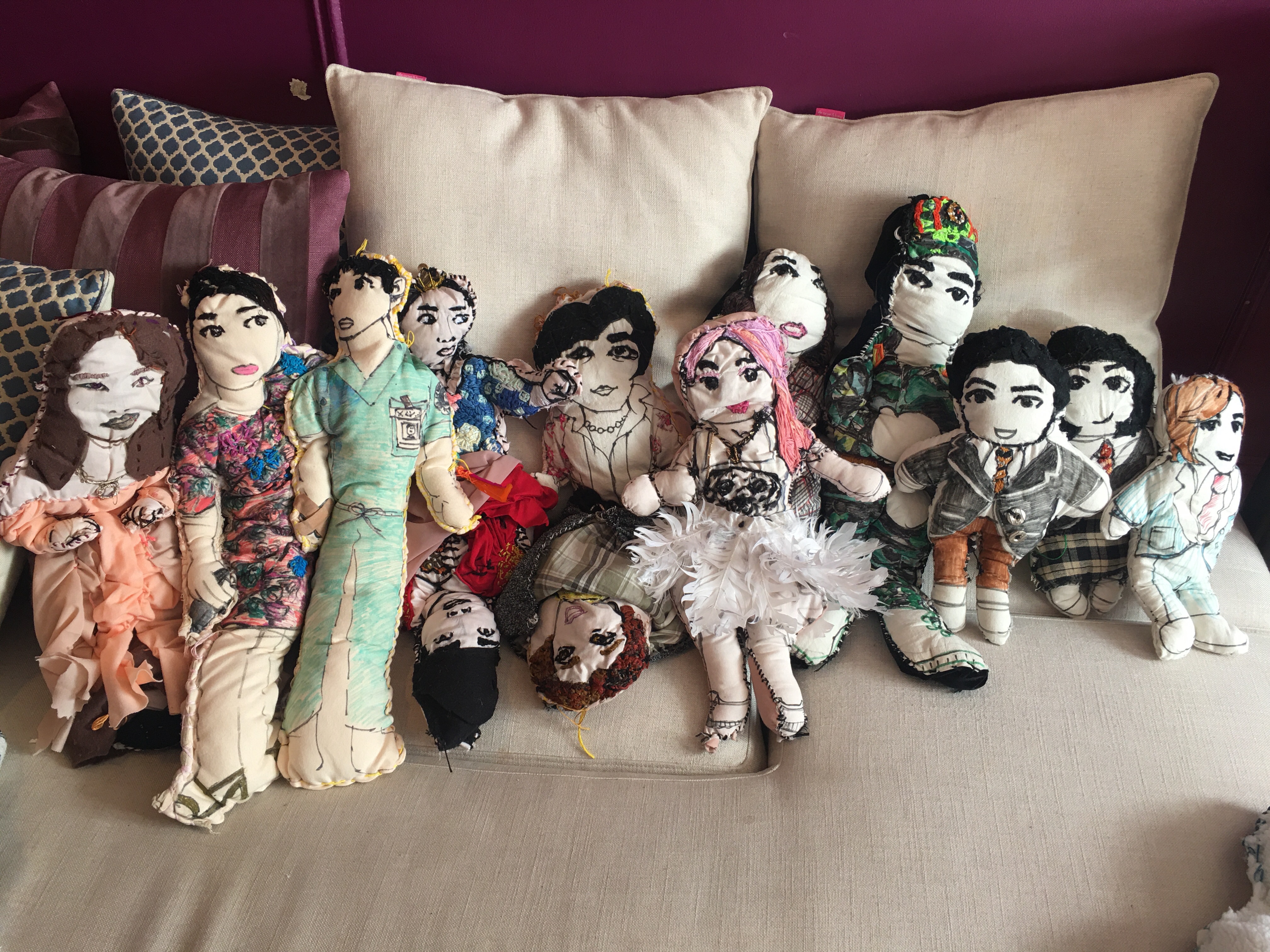
Hi. I am a fan of your writing and recently at work read an article you wrote about community lawyering that I admired. I’m a career legal services attorney at the New York Legal Assistance Group who lives with my family in Manhattan and writes whenever I can (often late at night for my blog, www.crazymiddleclassasian.com). I started this blog during the height of COVID in 2020 to playfully explore what it means to be a Korean-American adoptee who was raised Jewish by writing essays, showing off my Kdrama dolls/my drawings/Sculpies and doing short interviews with some Korean-American creators.
I’m trying to transition into writing professionally and was hoping you would consider chatting with me if you ever have a free moment. But if that’s too much for you, I am greedily hoping you would agree to do an emailed Q and A with me out of solidarity with me as another Korean-American attorney who is trying to bust out of the legal world to write every day. I know this is a long-shot but I pat myself on my back for trying! I would send you about 20 questions about your career shift, your creative process, and your Korean-American identity.
If you are curious about my Q and As and writing, these are some posts that you might enjoy.[I did include these in my email to her]. I have no specific time frame for my request because I don’t want to add restrictions that would impede you from saying yes!
To my delight and surprise, two days later, my doppelganger responded:
Hey Elissa, Great to connect. Call me anytime (and she included her phone number).
(Note to ETK: I will not be copying or discussing our future communications if we do speak. I’d only do that with your prior consent. I imagine that’s Journalism 101 that I heh, seem to have violated above. ).
This kind of polite though warm response from ETK makes me glad as a married lady I have no need to navigate the dating world because I am simply unable to decipher if this is a polite brush off or an actual declaration of interest. (I guess if I call and it’s a fake number, I’ll know!) I’m a bit gun shy because in the past, I’ve been ghosted by a well-meaning Korean-American ceramicist who agreed to have me send her a roster of questions for a Q and A only to two emails later ignore my emailed questions until they just festered.
I must forge a path for myself (chugga-chugga. Hear the little blue engine heading uphill) and steel myself for rejection. I will call ETK tommorrow. Or will I? Notably, I received her emailed response roughly ten days ago and I’ve waited to call her. But my family’s London vacation got in the way and there’s that pesky day job. And I did hem and haw. Why the hesitation for a simple little call? Perhaps it’s the idea that “seeing yourself as if from the outside is something like seeing a ghost, or being undead.” It makes you wonder, “What if the other you was more real than you? Or better at it?”
Maybe I need a mantra. Nothing fancy. A simple one from childhood will do: I think I can. I think I can. But if that’s not enough to quell the cacophony of self-doubt that runs through my brain, I’ll recall my friend Michelle’s encouraging reminder that I’m with all my flaws, loveably unique. I mean, does ETK make deranged-looking, sloppy fabric Korean drama dolls for fun?
I can also turn to the advice of author Naomi Klein whose previously mentioned book I managed to read with minimal skimming:
“I wrote Doppelganger because I am convinced that we can break out of our partitioned narratives, that we can look at and listen to and learn from our doubles, even the ones we most reject. It may be our only hope.”
Ooh world, watch me bust out of my partitioned narrative! As for you ETK, try not to back away slowly but you may be my only hope! For perhaps no one is better positioned than you to advise me on how to leave behind a familiar legal services career in my middle age years and get my writing more widely read. So, twinsie, let’s raise a glass to the two of us!
Epilogue: In the midst of writing this post, I just called ETK and left her a voicemail. So I’m ready to wait for it, wait for it.
May you all find your doppelgangers, and sponge up all their knowledge and truths (without giving up your essence!)
xoxo CMCA

 Crazy middle class asian