As a Korean-American adoptee who was left as a baby on the steps of a Seoul police station next to the famous, garishly pungent Noryangjin fish market, I’ve always been drawn to tales involving orphans, women who abandon their children and/or any other kind of familial estrangement. At age fifty-one —my old scars from early abandonment strangely intact — I’m interested in exploring what makes a woman reject motherhood/abandon her child.
These days, with declining birth rates around the globe, the increase of American women choosing not to be the primary caregiver, the reported uptick of American adults abandoning their parents and the phenomenon of young adults forsaking social outings for the comforts of bed, it seems like the perfect time to discuss the challenges of motherhood. For not only can motherhood be an isolating and expensive experience, but one of its carved-in-stone benefits—-having offspring who will provide you companionship, and eventually elder care—may be in question. Plus, there’s always the pet option! (With some amusement, I recently read that in South Korea, veterinarians’ salaries are rising faster than doctors’ salaries because people are choosing pets over kids). No wonder why young folks are going full-scale hermit— wary of socialization and procreation!
With all the work mothers do, we have been much maligned, blamed for societal ills and anointed in therapy sessions as the root cause of all problems (certainly more than fathers). Sometimes, this criticism is unwarranted. Other times, moms deserve the ire. Recently my son told me that the beloved teacher of his high school Sociology of Education class, occasionally shares embarrassingly meddlesome emails that parents (mostly mothers) from past classes have sent to her over the years, as examples of the over-reach of entitled, private school parents who are always trying to advocate for their offspring. For instance, one mother angrily demanded a teacher conference to discuss how to decrease the weight of her high school son’s backpack. (Of course, in reading these emails to students, this teacher crossed out all names and identifying information of the subject parent.) In telling a few of my friends about this teacher’s methods, most of them thought sharing parent emails was completely inappropriate. I’m probably an outlier; I find this teaching material pretty amusing and possibly illustrative/educational. I mean, Fuck Entitlement!
In the past, I’ve gleefully written about two types of mothers: vixens v. clowns—a purposely reductive and silly way to categorize mothers. (See my Vixen essays 1-4) As portrayed in numerous Korean dramas, vixens are glamorous CEOs of department store conglomerates who are shitty, emotionally withholding mothers. They, like the CEO mom in Boys over Flowers who left her children alone every Christmas with the servants, are ambitious, self-serving and seemingly only capable of fixed and finite interactions with their children. I note that they are also impeccably coiffed and and dressed. (Fitting in with Miriam-Webster’s definition of a vixen, these moms are also shrewish and ill-tempered).
Whereas the Clown Mom is an all-giving, warm caregiver who is possibly overly invested in parenting and views self-care as indulgent—as evident in her frazzled grooming and unflattering, devil-may-care sartorial choices. (See my past Vixen v. Clown Quiz to see who you are). Clown Moms get on the floor and roll around with their kids. They do crafts. They are willing snugglers and sing their kids praises on the daily.
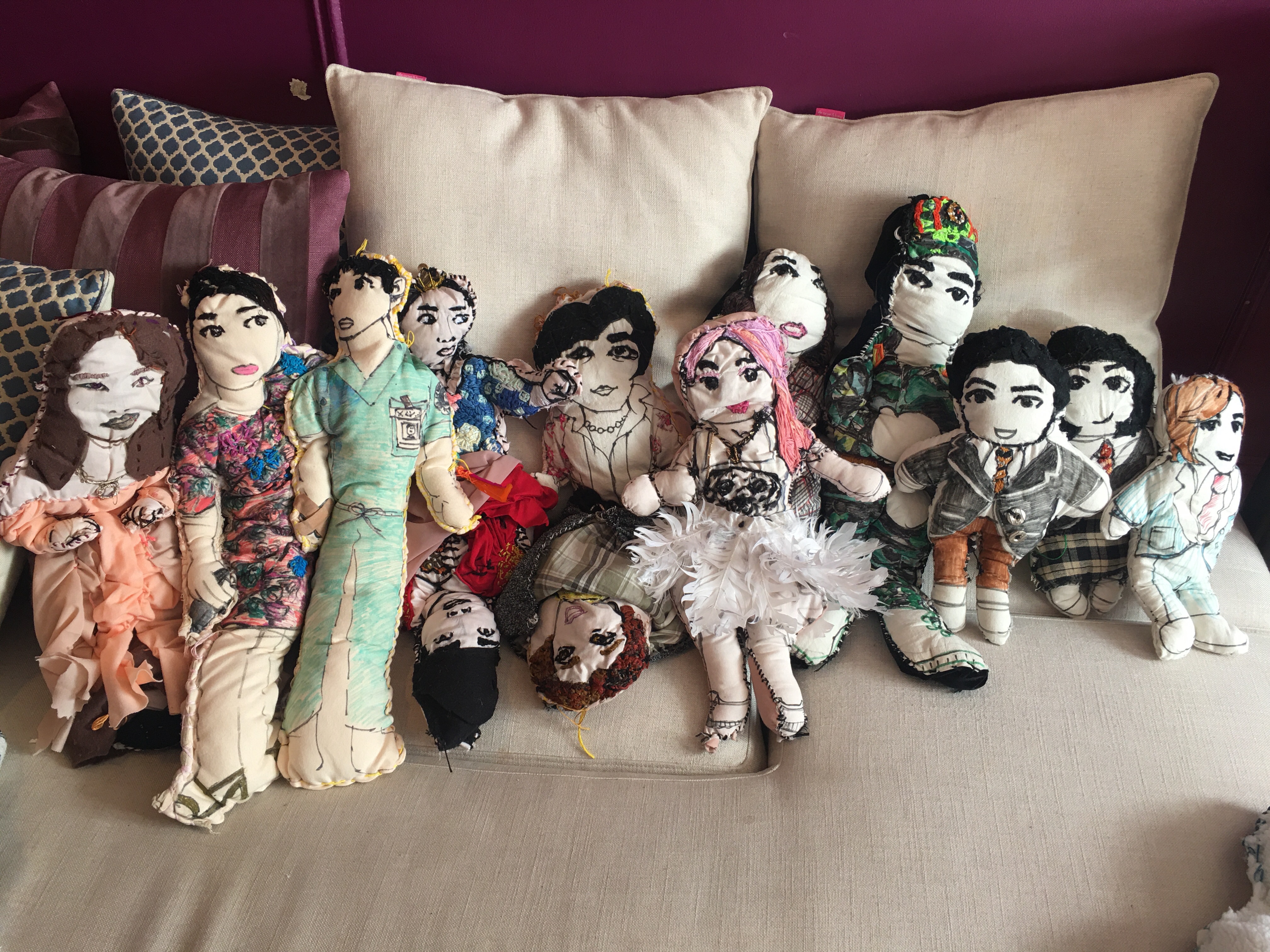
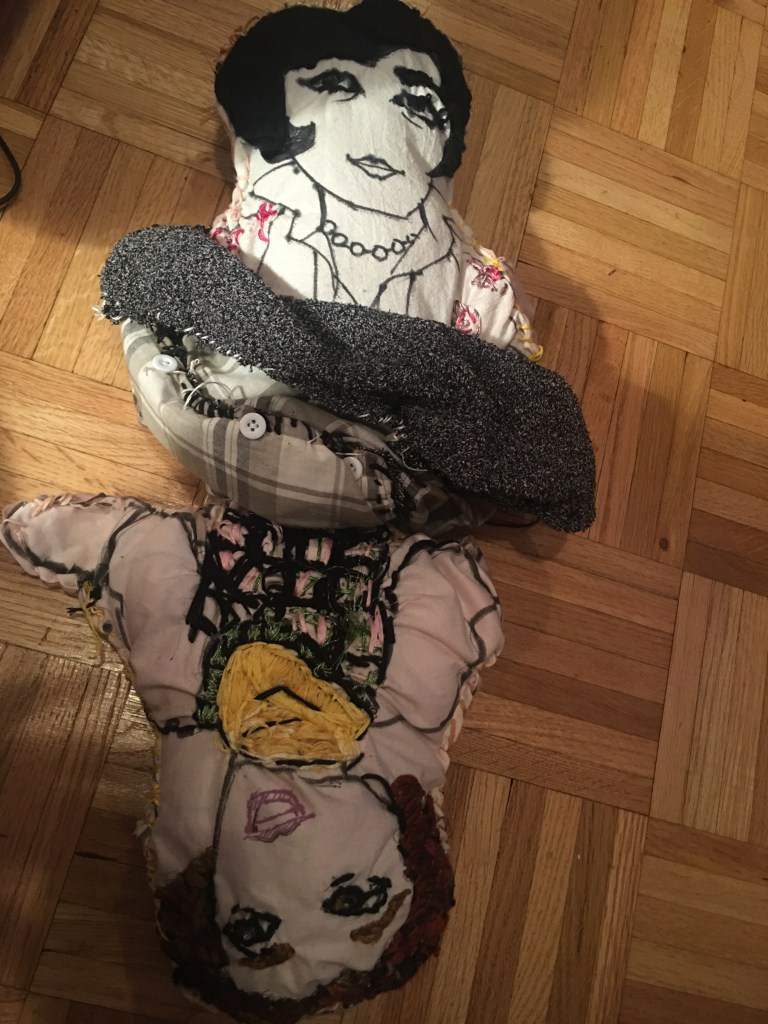
As my very scientific quiz that I created revealed, I am more of a Clown Mom than a Vixen. See me seated across a table from two dear friends at a sushi restaurant the other night after having briskly slapped some tinted moisturizer on my visage in my bathroom mirror. My friends giggled and informed me that my eyelashes looked oddly beige (giving me an unintended Twiggy, 60’s mod-alien look). Sure, there’s abundant other evidence that I belong in big rubber shoes, e.g.,I’m an admittedly indulgent mother who is no stranger to the conditional no; I’m the self-appointed Pied Piper of Arts and Crafts—most recently drawing angry Dance Moms for my nine-year old daughter’s recent Dance Moms-themed birthday party. (See my drawn cups below)

I certainly don’t identify with the Corporate Vixen Moms in Korean dramas like the iconic Boys over Flowers or Crash Landing on You. I can’t imagine forsaking time with my family for a corporate office job (irrespective of the accumulation of wealth and status! ) Though I note, some of these prestige law firms I’ve visited over the years have nice perks like magically-appearing, delectably warm chocolate chip cookies in conference rooms and once, an actual bin of overflowing Blackwing pencils that were practically begging to be cased. Blackwings! I mean, why waste those on corporate lawyers?
When I was a young legal services lawyer, on occasion, I’d visit my husband at his White Shoe, supremely prim law firm office in midtown East and enjoy wearing my most outlandish outfits (e.g. my form-fitting pale grey p-leather pants that flared out Flamenco-style on one calf that I purchased at the Antique Boutique downtown). An affable, very senior partner at the firm who used to throw his team of attorneys (including my husband) an annual Christmas party in his posh Fifth Avenue apartment that solely consisted of platters of hummus and pita, used to give my outfits very subtle, patrician-style side-eye when I came to visit the office. He was no doubt envious of my ability to don party pants in the middle of the work week— a flagrant, joyous expression of self—while he was miserably bound in non-breathable pinstripes and a noose of a tie.
Though these days, I could use a little infusion of Corporate Vixen Mom in my sad, legal services-attorney wardrobe. You think I’d tire of my out-of-style, slightly-too-tight-in-the-shoulder blazers and array of black pants made of dubious, low quality material. (It’s been about a decade of mix and matching different shades of black to poor effect). Truthfully, I have had few style muses at my legal services office where we are, of course, modestly compensated. I recall once going to federal court with a senior female attorney who was definitely a free spirit (a lawyer/artist). She entered the federal courthouse wearing a sad sack Eileen Fisher-like linen dress and chunky sneakers, and in the hallways of federal court when no one was around, she rapidly pulled off her dress to reveal a similarly loose-fitting, I-don’t-give-a-fuck, bright purple linen skirt with plenty of wrinkles and a matching linen blazer—very unusual courtroom attire. (But she killed it in court so maybe clothes don’t make the woman).
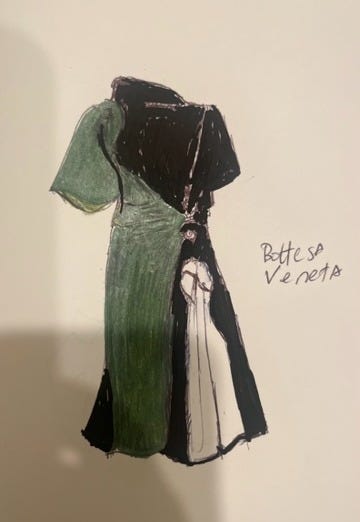
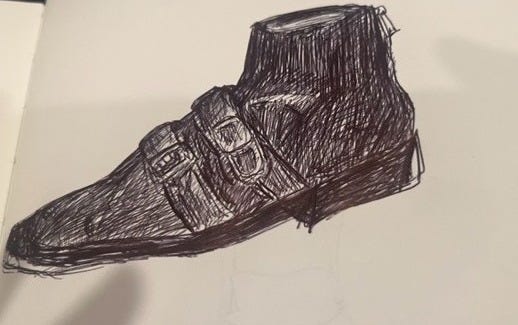
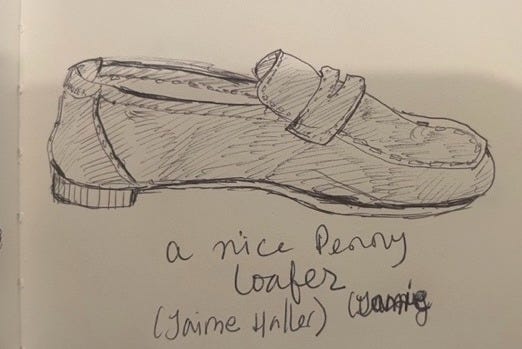
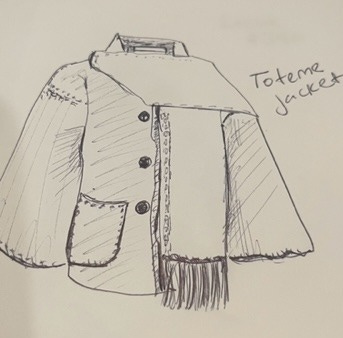
Just for fun, a few of my drawings of some current fashion online of things a Corporate Vixen might wear:
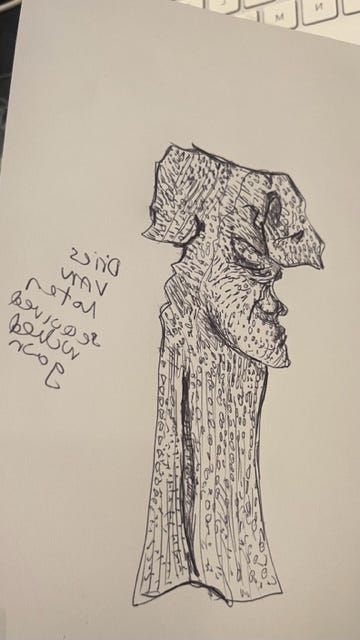
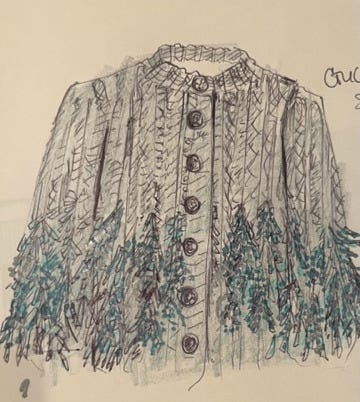
I better identify with a different kind of vixen. I’ll call her the BoVix (for Boho Vixen Mom) who is more commonly found in American pop culture—that is, the bohemian artist/writer who is consistently overwhelmed by motherhood, disinterested in societal convention and likely to make bad parental choices for the sake of her art. (Though unlike Corporate Vixen Mom, she’s not necessarily so stylish/put together. She lives in caftans—and we all know caftans can be either cute or downright frumpy.) For fun, I drew a lavish Gucci sweater a BoVix writer could only probably afford if she became the new Sally Rooney. I imagine wearing this at the writing residency that I have yet to apply to, sitting in a cafe pretending to work on my novel or even actually writing in some dreamy Nordic tree house resort.
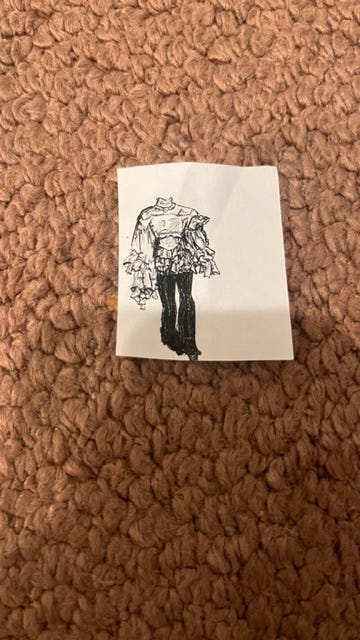
My husband recently told my kids at dinner (with me at the table weary after cooking dinner), that I’m a “free-spirit” and thus domestic chores, e.g., doing dishes, are particularly draining for me. I was amused because in our more than twenty-one year old marriage, I’d never heard him refer to me this way. But no doubt, worse things have been said about me so I’ll take it! For I do regularly abhor dish washing and family meal planning. (Once, while my family and I playfully discussed what words on a t-shirt would sum up each of our essences, my kids and husband agreed dish grump in small letters would be apt for mine.) It seems, I’m in good company when it comes to domestic chores. Apparently, the artist Alice Neal (who was definitely a BoVix) had no interest in household duties, noting a particular disdain for doing laundry. Solidarity sister!
My kids recently reminded me of a quirky little exchange I had with a young homeless woman on the streets of NYC around Spring 2021. My kids and I were enjoying one another’s company as we wove through some of my favorite East Village side streets to window shop and eat snacks. (I donned a floral print, satin-y COVID face mask that was less protective than decorative). A young, near-toothless homeless woman seated on an East 12th Street stoop looked up at me as I passed and called out “I love your mask!”
I slowed my pace and turned to her to make eye contact. “Thanks!” (I’m a glutton for a compliment)
“You have beautiful kids,” she said loud enough for me to hear on the busy street. “I can’t have kids and that kills me.”
With my kids flanking me, I froze in place to find something to say. I chose this pearl of wisdom: “Well, not having kids has its advantages too.”
I watched the stranger smile and made my way down the street—my kids tittering in my ear (rightfully puzzled and amused by my little exchange).
Though I’m not exactly sure what I’d meant to tell this lady, I may have been alluding to the maternal malaise/frustration that the highly quotable British writer Doris Lessing addressed when she wrote: “I haven’t yet met a woman who isn’t bitterly rebellious…wanting children, but resenting them because of the way we are cribbed cabined and confined.” Of course, Ms. Lessing and I are distinct (on many levels other than her vast literary accomplishments). She left her two older children to their father to write a novel at some point, which I’d never do (at least not for a trauma-inducing long time.) Plus, I’m aware of my relative privileges, e.g. the ability to afford childcare and work a flexible part-time job that make it hard to cry for myself and easy to be sympathetic to Ms. Lessing’s struggle. Regardless, despite these privileges, I do occasionally feel glum when the most leaden parts of domestic life and my day job as a legal services attorney infringe on my precious time to make things and write. (I don’t resent my kids though! They are majestic souls that fill me with wonderment and joy (especially now that they are past toddler hood!)).
In writing this post, my mind naturally drifts to questions about my unknown birth mom—that shirker of parental responsibilities. The one that got away. Though in reality, she’ll be forever shrouded by a veil, sometimes she appears in my mind, a forlorn, straggly teenager with prematurely leathery dark skin (a badge of steady field work in some South Korean rice paddies) and of course, my squishy round nose. Only this past week while writing this essay, have I imagined my mother as a bohemian artist/writer/creator. The thought had never before crossed because I perhaps ignorantly believed that South Korea was impoverished in the 1970’s and that there were probably not many people trying to make livings in the Arts. But to have never imagined her as a creator, I must have a limited scope of the imagination!*
Could this imagined birth mom— a slim Korean woman in her thirties with her thick black hair held back by a boldly-hued silk scarf and the nubby, stained nails of a painter have left me on the cold Noryangjin police station steps in 1970’s South Korea? Perhaps she was impoverished, without a supportive partner, prickly from the sound of my piercing baby wail and/or weary of attending to me 24/7 when she wanted to create art/make stuff. Would I judge my birth mom less harshly for abandoning me if I learned she was a creative genius akin to artist Alice Neel or writer Doris Lessing (two free-spirits whose response to being constrained by societal conventions was to abandon their children for a long period of time)? Can you be a successful, productive artist/writer and a good mother at the same time?
The above questions crossed my mind as I recently watched two fine films about BoVixes, including The Lost Daughter (based on the Elena Ferrante novel) and the documentary Alice Neal. The Lost Daughter introduces us to Lena (played by actress Olivia Coleman), a middle-aged Harvard English professor who travels alone to a Grecian island on vacation and becomes entangled with a crass American family—including a beautiful young mother (played by Dakota Johnson) who’s visibly overwhelmed caring for her toddler daughter. (Lena’s identification with the young mother, leads her down a dark and twisted path which I won’t spoil for you.)
The film was so compelling in great part due to Olivia Coleman’s nuanced portrayal of Lena. In flashbacks, we see Lena as a young mother struggling to balance motherhood and her career, which leads her to leave her two young daughters with their father for three years to pursue her career abroad. On one hand, I felt some empathy for her that her husband who’d always been the one traveling and leaving her to be the sole caregiver, later becomes furious when she turned the tables and expected him to be the primary caregiver. But I felt wrenched and still as I watched the scene of Lena returning home three years later; the pain and confusion apparent on her daughters’ faces as she reaches out to embrace them was hard to watch. What unspeakable treachery!
In the same night, I watched Alice Neel, the 2007 documentary about one of my favorite artists who was an unconventional mother to say the least: she not only let her husband take her young daughter abroad—effectively abandoning her — she later stayed with her subsequent, abusive boyfriend even after learning he had been physically abusive to her son.(I am not really casting judgment on her as I know women who are abused often have complex reasons for not leaving their abusers)
Admittedly, watching these two films back-to-back made for a tense evening; for I absorbed these well-done films in a fluctuating state of discomfort/ mild guilt for relating to some scenes where Lena was overwhelmed/disinterested in domestic responsibilities and finger-wagging horror/judgment of these two mothers who did things I’d never do in the name of Art and freedom. One scene with Lena telling her suave professor lover (played by Peter Sarsgaard) that she hates phoning her young daughter when she is away from her, hit home because I recall that during early motherhood I sometimes felt my long-distance calls with my kids (who had appropriately nascent, ruddy conversational skills) were mildly torturous. And sometimes, like Lena— overwhelmed with domestic duties—I have shirked my boo- boo kissing duties and wished I could stop their whining like I did in their baby days—lodging a pacifier in their mouths.
The conflict between motherhood and making great art is made abundantly clear in Alice Neel. As the film maker himself noted, Alice Neel needed to be an “open vein” in order to make her paintings. We, the viewer, learn that for Alice being an open vein meant doing things that ranged from the wildly inconsiderate like allowing guests who visited her railroad-style apartment traipse through her sons’ bedrooms at all hours of the night to get to her studio, to the most extreme—e.g., not protecting her son from physical abuse by a longtime lover of hers and as mentioned before, effectively abandoning her daughter by letting her father take her abroad and failing to keep in touch.
Despite all this, one of Ms. Neel’s sons explains in the documentary, noticeably a little hesitant/guarded, that “she was a good mom.” He said that she may not have provided him the protection he needed but she exposed him to intellectual ideas and art—certainly a novel definition of a good mother. (This provoked me to tell my mildly amused teenage son the other day, “Well, I can’t provide you with rollicking dinners with public intellectuals and artists like you’d probably like (as he’s expressed dismay that we don’t travel in these circles), but I do protect you.”)
Looking up possible causes for maternal abandonment for this newsletter was a hair unsettling. Could my birth mother have been mentally ill, and if so, did that at least partially explain her abandonment? For, I learned Alice Neel was suicidal and institutionalized after her daughter left with her father, which surely played a part in her failure to keep in touch with her daughter. I’d never thought of this possibility, which is funny as I do have pretty run-of -the-mill, mild to moderate depression (that is thankfully largely under control. ((If you have the blues birth mom, I’d like to hold you close for maybe giving me up was beyond your control.) Next, I am imagining that maybe my mother was running from an abusive relationship (as that is one reason mothers are forced to leave their children.) and that smarts too because Iike the fantasy of having a nice nuclear family somewhere in South Korea. I’ll never know but hypothesizing this way about my birth mother sure makes me feel warmth towards her shadowed figure.
Sometimes, I dream of taking a month to travel solo or do a writer’s residency during the busiest season for us parents-the Fall—and not have to wait until the kids are in camp in the summer.It would feel radical to put myself before my children like this. What if I missed a dance recital? A school play? To justify something like this, I’d have to have won a major prize or something marking me as a serious writer with no choice. Otherwise, I’d be the asshole.
How interesting to consider that women in the U.S. are so harshly judged for leaving their children for prolonged periods, even when they leave them with capable fathers in pursuit of a career/more education; while in certain Asian societies e.g. the Philippines, it is supposedly more common and accepted for mothers to leave their children with other relatives for long periods of time to pursue jobs and education elsewhere. I also know, at least in the not so far off past, it wasn’t uncommon/frowned upon for South Korean families to send their young children to permanently move in with American relatives to pursue educational and professional opportunities that would be harder to achieve in South Korea. Wouldn’t it be nice if women here had the option of pursuing their own interests/careers-free of societal aspersions—so long as their kids were well cared for by other loved ones? Might motherhood be more appealing now (leading to higher birth rates) if we had more freedom of movement/ less lowered eyes in our direction when we carefully considered out children’s needs and responsibly pursued our bliss? I imagine so.
In Alice Neel, her grown son observes that a lot of people want distinction without risk and that if his mother had followed the paradym for what was expected of women, she’d not have accomplished what she did.
He’s right, I’m all about distinction without risk. I want to be an “open vein” so I can write an opus and pursue my myriad creative ideas without leaving a path of destruction in my wake. Thankfully for us creative mothers out there today, there are less drastic fixes than abandoning one’s children!
So here’s to pursuing your bliss and creativity as much as you can!
In addition to planning a tree house tour of the world, I am ready to acknowledge and celebrate my inner-vixen. This could mean forgiving myself if I ‘m sometimes shrewish and ill-tempered after coming home from work to cook, clean and care give. I will limit my social time to friends who like to talk about more than their kids’ sports games, accomplishments and social lives. I will remember to prioritize self-care (though as a predominant clown mom, I often falter); I recently joined a gym and huff and puff there twice a week; I will embrace my bathroom cabinet that is newly stocked with quality skincare products so that this Asian don’t raisin! Oh and I enjoy this luxe Victoria Beckham moisturizing lip gloss I just purchased. It brings me a disproportionate amount of joy.
What else?
Sure I am disquieted to read Doris Lessing’s warning that “I can’t think which is more satisfactory, having a baby, or writing a novel. Unfortunately they are quite incompatible.” And I’m still set on my novel, despite the difficulty I’ve had writing it. In BoVix style, when my kids go to sleep, I will preserve my right to be a stone-cold Medusa. On nights that I have the requisite focus, I sit at my fortress—my desk that is flanked by my favorite novels, journals and carousel of my favorite pens/pencil— and type on my computer to the soundtrack of my unwieldy but satisfying Spotify mix. My ideas are like thrashing snakes on my crown. Trespassers beware! Even the guilt-inducing call of my elderly out-of-state mother will go unanswered. Say my sweet cherub of a daughter wakes up and wants a glass of water? Sure I’ll dutifully fetch it and tuck her into bed(but I may be a pinch rushed!). (Other vixen moves: occasionally going to a Airbnb on my own to write for a weekend and applying for summer writer residencies when my kids are at camp. Notably, my past celebration of my fiftieth birthday in the Berkshires with friends, entailed missing my daughter’s school marathon that most parents attend to cheer for their kids. She still reminds me I missed it. But I (sheep-ishly) admit it was worth it.
P.S. I just bought, The Baby on the Fire Escape: Creativity, Motherhood, and the Mind-Baby Problem by Julie Phillips that sounds relevant to this post and is already an interesting read. Highly recommend.
Open those veins!! xoxo
*favorite phrase of the character Anne from Anne with an E

 Crazy middle class asian