
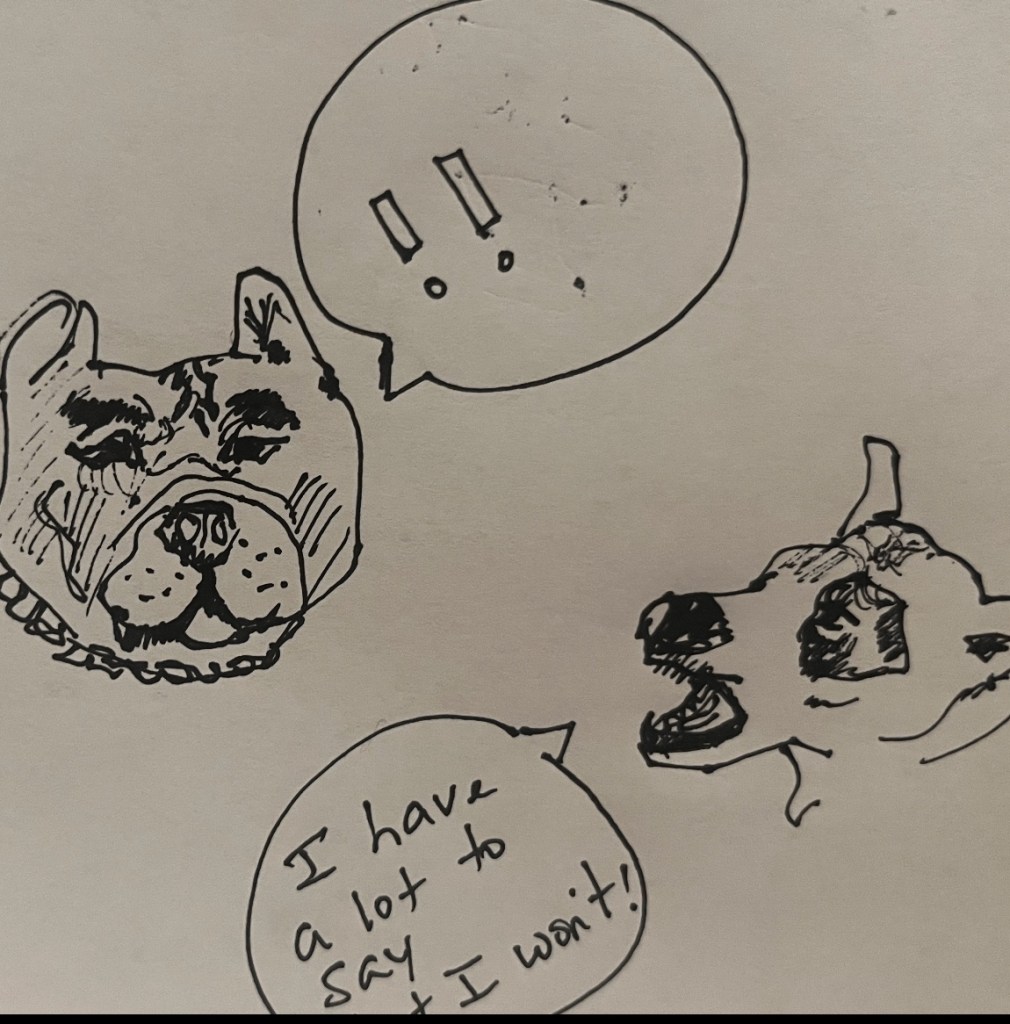
It is no secret that the holidays can be a fraught time for many people, given the decreased sunlight, financial strain from gift expenses and of course increased contact with relatives in intense spurts. I think of a friend’s tale of her father losing his job right before Christmas one year and looking out her kitchen window to see him outside in their front yard pre-maturely wrestling their fully decorated Christmas tree to the ground–his way of releasing his fury and officially ending the family’s holiday cheer.
I’ve heard friends’ reports of increased household tensions and I too, have noticed my temper flare up of late. As someone branded a bit of a hot head under stress, I find this Korean expression, quite appropro/potentially useful this holiday season.
Here is an example of language I used in a fight that happened years ago that was not de-escalating:
My Father in Law (furiously glaring at me from the front of seat of his car): “You treat my wife like a slave. You woke her up to take care of your kids today.”
ME: (in the passenger seat not yelling but responding in a sour/agitated tone, and newsflash: tone is EVERYTHING): “If you want to have a fight with me, that’s a great way to do it.”
My words caused him to slam his car breaks and glare at me, enraged. My reaction was to exit the car that was already on the road and run back to the house in order to escape further conflict.
I wonder now what would have happened if I’d opted for, “I have much to say, but I won’t.” I suspect that phrase wouldn’t have helped much because it’s so passive-aggressive but who knows, I might whip out this expression in an emergency and see how I do. Try it too and let me know how it goes for you!
Just for fun, I ponder how this old argument would have gone if I had applied some FBI techniques for de-escalating conflicts.
“Mirroring is a communication technique in which you repeat the last few words of what someone just said. This reassures the other person that you are listening closely to them. It’s also an easy strategy to give yourself some mental breathing room so you don’t get overwhelmed in a stressful situation. Mirroring is particularly effective when you repeat the words with a different inflection, like turning a statement into a question. This gives the other person the opportunity to either confirm or back off of their original statement.”
So, what if I had applied this technique to my fight?
FIL: “You treat my wife like a slave. You woke her up to take care of your kids today.”
ME: “I treat like her like a slave and woke her up to take care of my kids today?”
(So far I’m not impressed, FBI. I’m pretty sure FIL would have just repeated his displeased words).
What if I had used the FBI technique of emotional labeling, (which is helping the aggressor name their emotions)?
FIL: “You treat my wife like a slave. You woke her up to take care of your kids today.”
ME: “It seems you are pretty angry at me for treating your wife like a slave and waking her up to take care of my kids?”
(I think you’d agree, this wouldn’t moved the needle towards peaceful resolution).
What if I’d offered him food/water–that is, applied the FBI technique of doing something to show good faith? Sure, I could have offered him a bowl of ice cream for that seems to be his weakness but that’d be hard in a car. Though, regardless, it might have been a good technique to confuse him as it’s pretty odd behavior to offer someone ice cream in response to their aggression. (This reminds me of my sweet, eccentric former neighbor whose response to our nutty neighbor’s chronic, deeply seated hostility towards him, was to buy her a fruit pie. This method, sorry to report, was not effective).
As expected, this post is probably useless and has certainly not improved my opinion of the FBI as a nefarious, nebulously-useful agency. Though I do appreciate this summary below by Gary Noesner, a former hostage negotiator and author of Stalling for Time: My Life as an FBI Hostage Negotiator:
“Negotiators generally achieve peaceful resolutions only after they demonstrate their desire to be nonjudgmental, nonthreatening, and understanding of the subject’s feelings. By projecting that understanding, negotiators show empathy and lead the subject to perceive them, not as the enemy, but as concerned individuals who want to help.”
Years after the fight, I can acknowledge that I had no game when it came to de-escalation. I showed no interest in my FIL’s perspective or empathy for him despite the fact that he hosted my family and I in his house during COVID for many months. Maybe he was just tired of all the cohabitating. After all, I am an involuntary hair shedder and sometimes one of my long black strands goes errant. Ew.
However, I pat my own back now, for I don’t need the FBI to tell me what I already know: the best way to control my temper when faced with an aggressor, is to flee the scene (as I wisely did with my cantankerous FIL). My feet hit the pavement so hard and I ran with gazelle-like speed until I reached my in laws’ house. When you are a hot head, running away is a worthy option!
Although another FBI alternative–being silent– is the best response for some, I’ve found it’s impossible for me to be silent when faced with hostility. (Though, I applaud the judicious and level-headed of you who can do this). This makes me certain, I am not temperamentally suited for a wide range of jobs: hostage negotiator, spy, mediator/ judge. (I’m imagining a hostage taker throwing an insult my way as I try to negotiate with him that cuts me to the core–e.g., “you are less interesting than you think you are” or “you are a talentless, crooked-toothed hack”–and having me give him the bird to poor result).
The FBI agent’s final piece of advice about de-escalation is to project calmness by choosing your words carefully so you don’t further inflame the situation, speak slowly and pay attention to your nonverbal communication, e.g. maintain a neutral expression. But I have no Poker face.
As someone who is on the verge of throwing up each time I watch the scene in the Tarantino film, Inglorious Bastards, in which the farmer who is hiding a Jewish family under his floor boards during World War II has to serve a glass of milk to the Nazi entering his home–his face and mannerisms so composed–I cannot fathom being able to, in real life, effectively project calmness when I am hysterical inside. (In this brilliant, iconic scene, the knowing Nazi subtly touches a young girl’s wrist to feel her pulse as she runs around the kitchen with her sisters to get him the milk, in order to gage her anxiety level. If you somehow never saw this film, try watching that scene and taking your pulse. I will bow to you and encourage you to pursue the aforementioned careers I dismissed for myself, if you maintain a regular pulse).
So, that said, with my meager ability to restrain my emotions, I may forever be a provacateur/an escalator of arguments. But at least I’m a lovable fire-cracker!?
I wish you luck with your families and other loved ones this holiday season! If there are any conflicts, don’t do what I’d do (except, my deer-in-flight response is valid).
xoxo


 Crazy middle class asian